
Many facility managers find switching to a new commercial company challenging. They stay with an underperforming vendor for months, or even years, because they worry that a transition will mean missed cleanings, confused staff, or an awkward gap between contracts. That worry is understandable, but it’s largely avoidable with the right sequence of steps.
A clean transition comes down to timing, documentation, and communication. Handled properly, employees and visitors to your building should never notice the switch happened at all.
Why Do Businesses Delay Switching Commercial Cleaning Companies?
Most facility managers can list the reasons their current cleaning company isn’t working: inconsistent quality
- high staff turnover on the cleaning crew
- missed supply restocks
- An account manager who never returns calls.
Despite this, the switch gets postponed because of three fears:
Contract complications
Nobody wants to end up in a dispute over an early termination clause or a surprise fee.
Coverage gaps
A single missed night of cleaning in a medical office or food service facility can create real problems, not just cosmetic ones.
Staff disruption
Employees get used to a certain routine, and a botched handoff (wrong door codes, missing keys, an alarm that won’t disarm) creates a bad first impression of the new vendor before they’ve even started.
None of these risks are eliminated by staying with a vendor that isn’t performing. They’re managed by planning the switch effectively.
Step 1: Review Your Current Contract Before You Do Anything Else
Before contacting a new vendor, pull the current contract and confirm three things: the notice period required to terminate, whether there’s an automatic renewal clause, and whether early termination triggers a fee. Most commercial cleaning contracts require 30 to 90 days’ written notice. Missing that window can lock a business into another full term even after a new vendor is lined up.
If the contract includes a performance clause tied to service standards, documented failures (missed cleanings, quality complaints, safety violations) may allow an earlier exit without penalty. This is worth a conversation with legal counsel if the stakes are high enough, particularly for multi-location or multi-year agreements.
Step 2: Document the Current Scope of Work in Detail
Many businesses switch vendors without ever writing down what’s actually being cleaned, how often, and to what standard. This creates two problems: the new vendor may quote based on assumptions rather than reality, and any gaps in the handoff become hard to identify until something gets missed.
Before the transition, put together a working document covering:
- Every space serviced and its cleaning frequency
- Specific tasks tied to each space (floor care, restroom restocking, trash removal, disinfection protocols)
- Any specialty requirements (medical-grade disinfection, food service sanitation, high-security access areas)
- Supply and equipment ownership (what belongs to the current vendor versus what stays on-site)
- Access logistics (keys, fobs, alarm codes, parking, loading dock hours)
This document becomes the specification the new vendor bids against. You can also use the document as a checklist to confirm nothing was dropped during the switch.
Step 3: Overlap the Timelines, Don’t Leave a Gap
The single biggest driver of operational disruption during a vendor switch is a coverage gap between the last cleaning under the old contract and the first cleaning under the new one. Even a two- or three-day gap is noticeable in a busy office, and it’s a serious problem in a healthcare or food service setting.
The safest approach is a short overlap period, typically one to two weeks, where the new vendor has completed a walkthrough, received keys and access credentials, and is ready to begin on a specific start date that falls before or immediately at the end of the old contract’s notice period. This also gives the new vendor a chance to catch anything the scope-of-work document missed, since walking a facility in person surfaces details a written spec can’t fully capture.
Step 4: Handle Access and Security Changes on Day One
Old key sets, door codes, and alarm credentials should be deactivated the same day the previous vendor’s contract ends, not days or weeks later. This is a security step as much as an operational one. A facility manager should keep a simple checklist:
- Physical keys collected and old locks rekeyed if master keys were issued
- Alarm codes changed and old codes deactivated
- Building access fobs or cards deactivated in the system
- Any shared vendor logins (for supply ordering portals, scheduling apps) closed out
Handling this on the same day, rather than “sometime that week,” closes the most common security gap in a vendor transition.
Step 5: Communicate the Change to Staff Before It Happens
Employees should know a new cleaning company is starting before the new crew shows up, not after.
A short internal notice, even just a companywide email, covering the start date, any temporary changes to routine (a different cleaning window, a new supply closet location), and a point of contact for feedback prevents confusion and gives staff a channel to report problems in the first weeks rather than staying quiet about them.
Step 6: Set a 30-Day Check-In With the New Vendor
The first month with a new commercial cleaning company is the period where small issues either get corrected or become the norm.
A scheduled 30-day walkthrough with the new account manager, referencing the original scope-of-work document, is the easiest way to confirm the transition actually delivered what was promised. The 30-day check-in is the point to flag any tasks that were in the old contract but didn’t make it into the new one.
Answers to Frequently Asked Questions for Facilities Managers Switching Commercial Cleaning Vendors
How much notice do I need to give my current cleaning company?
Most commercial cleaning contracts require 30 to 90 days’ written notice before termination. Check the specific contract for the exact window, since it varies by vendor and contract length, and note whether the agreement includes an automatic renewal clause that could extend the term if notice isn’t given in time.
Can I switch cleaning companies before my contract ends?
Sometimes. If the contract includes a performance or service-standard clause and the current vendor has documented failures, such as missed cleanings or repeated quality complaints, there may be grounds for early termination without a penalty. This is worth reviewing with legal counsel, particularly for larger or multi-year contracts.
How long should the transition between vendors take?
A one- to two-week overlap between the outgoing and incoming vendor is typical. This allows the new company to complete a walkthrough, receive access credentials, and start service before the old contract’s notice period ends, avoiding any coverage gap.
What should I include in a scope-of-work document for the new vendor?
List every space serviced, the frequency of cleaning, specific tasks per space, any specialty requirements like medical-grade disinfection, who owns the cleaning supplies and equipment, and the access logistics for keys, codes, and building hours. This document also serves as the checklist for confirming the new vendor covers everything the old one did.
When should old keys and access codes be deactivated?
On the same day the previous vendor’s contract ends. Waiting even a few days creates an unnecessary security gap. This includes physical keys, alarm codes, building access fobs, and any shared logins to supply or scheduling systems.
Should employees be told about the switch in advance?
Yes. A short notice before the new crew arrives, covering the start date and any temporary changes to routine, prevents confusion and gives staff a way to report problems directly rather than staying quiet about issues in the first weeks.
What’s the best way to confirm the new vendor is meeting expectations?
Schedule a 30-day walkthrough with the new account manager and reference the original scope-of-work document line by line. This is the clearest way to catch any tasks that were missed in the transition before they become a longer-term problem.
Book a Free Quote with Mass Commercial Cleaning for Employee-Owned Reliability Built on Decades of Experience
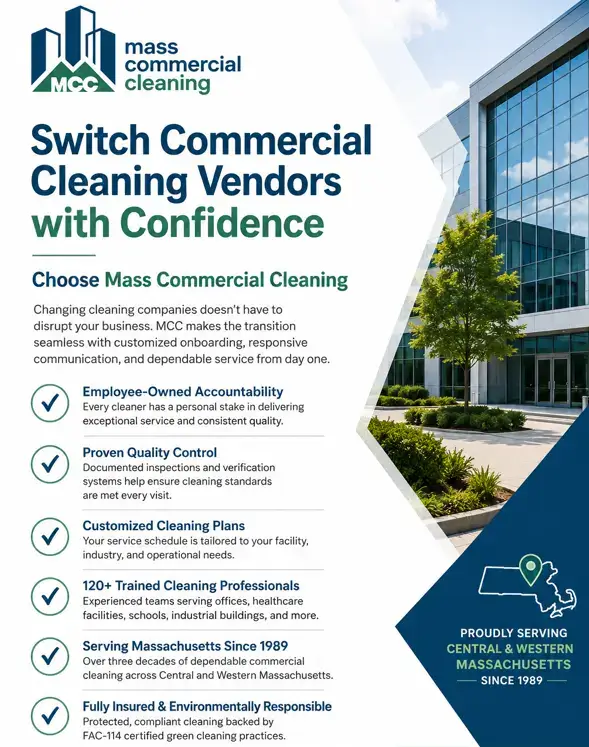
If you’re in the process of switching commercial cleaning vendors, you can call our cleaning experts at Mass Commercial Cleaning for help navigating the process. We’ll begin with a building walkthrough and quote and then help you streamline the transition to a leading Massachusetts cleaning service.
