A restroom that looked fine on Monday can smell off by Thursday. Baseboards collect a gray film that no amount of daily mopping seems to touch. Vents grow a soft coat of dust that nobody notices until a visitor points up and asks about it. Many Massachusetts facilities pass a quick glance and still aren’t getting the detailed attention that keeps a building genuinely clean over time.
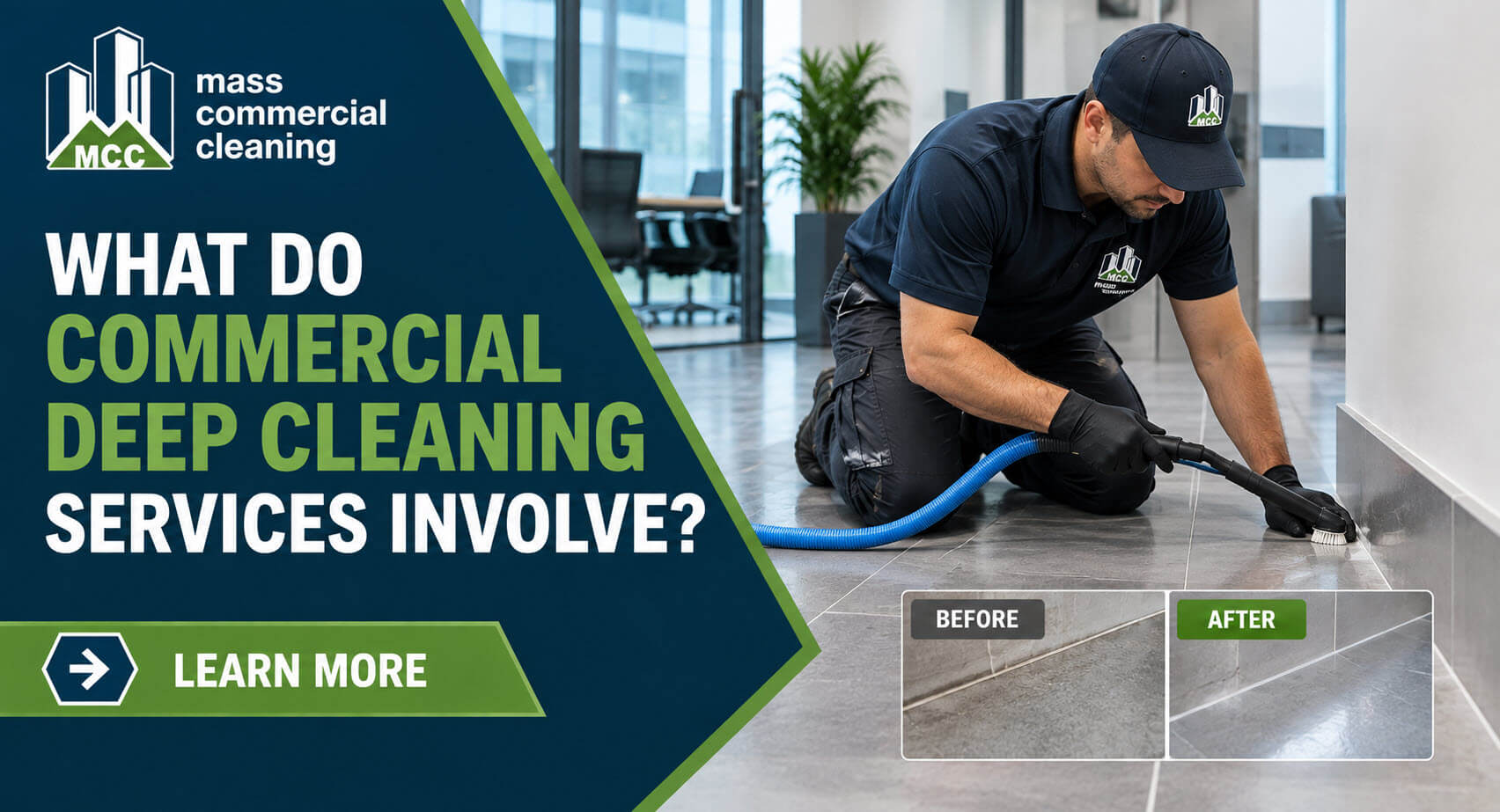
This is where commercial deep cleaning comes in. Commercial deep cleaning is a planned, detailed cleaning process that targets high-use, hard-to-reach, and heavily soiled areas that routine daily or weekly service typically doesn’t reach. Where standard janitorial services keep a building presentable day to day, a deep clean resets it, addressing buildup that accumulates over weeks or months.
Routine cleaning and deep cleaning aren’t competing services. They work together: daily upkeep maintains appearance, while periodic deep cleaning restores the details that daily work can’t cover on its own. Mass Commercial Cleaning provides commercial cleaning services for businesses throughout Massachusetts, and in this guide we will walk you through what a deep clean actually includes, when a facility needs one, and how to evaluate a provider before you hire one.
Below, we’ll cover the specific tasks involved, how deep cleaning differs from routine janitorial work, the signs that indicate your facility is due, and what to expect from a professional provider from first walkthrough to final inspection.
What Is Commercial Deep Cleaning?
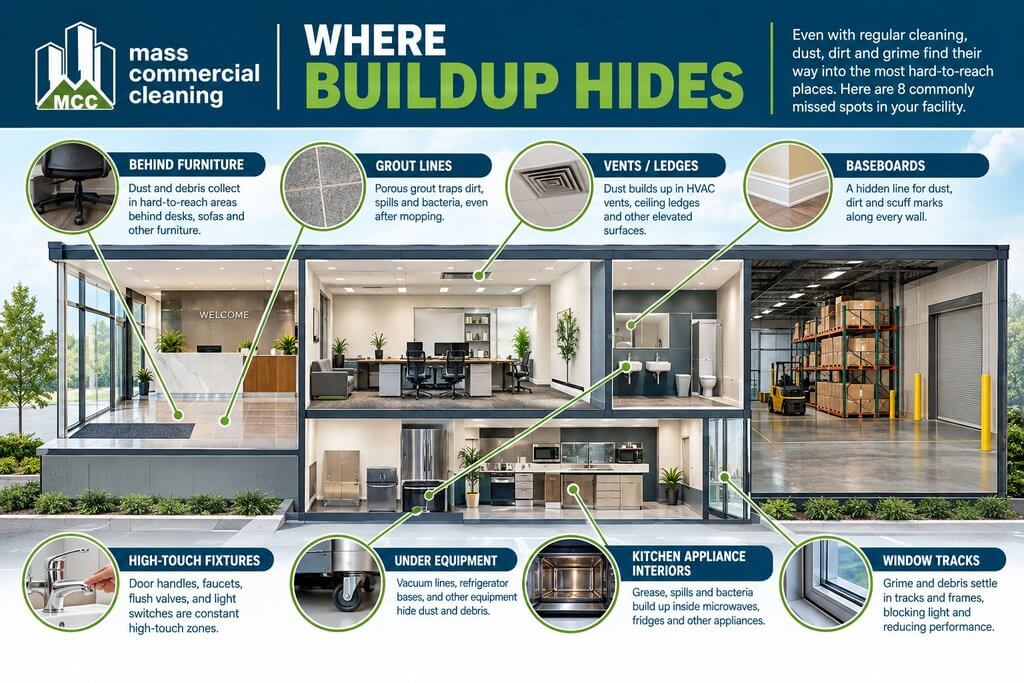
Commercial deep cleaning is a scheduled, detailed cleaning service that goes beyond the surface-level tasks performed during routine janitorial visits. Rather than wiping down what’s visible and moving on, a deep clean targets buildup in places that get missed during everyday service. For example:
- behind and under furniture,
- inside grout lines,
- along baseboards,
- on vents and ledges, and
- around fixtures that see heavy daily contact.
The scope of a deep clean isn’t standardized from one building to the next. A medical office, a warehouse, and a bank lobby all accumulate dirt differently, and each has different surfaces, foot traffic patterns, and operational schedules. A facility with polished concrete floors and forklift traffic needs a different approach than a carpeted office suite with cubicles and shared equipment. That’s why a responsible provider starts with an assessment of the space rather than applying a generic checklist to every building.
A common mistake facility managers make is assuming that “deep cleaning” means the same list of tasks everywhere. In practice, the priorities shift based on what’s actually accumulating in that specific building, how long it’s been since the last intensive cleaning, and what the facility uses its space for day to day.
Commercial Deep Cleaning at a Glance
- It is a scheduled, detailed cleaning process, not an everyday task.
- It addresses buildup in high-use, hard-to-reach, or frequently overlooked areas.
- It differs from routine janitorial work in depth, frequency, and the equipment used.
- The scope should be customized to the facility’s layout, surfaces, and traffic patterns.
- It works alongside routine cleaning rather than replacing it.
- It typically follows a walkthrough and a documented plan, not a fixed, one-size-fits-all package.
Commercial Deep Cleaning vs. Routine Janitorial Cleaning
Facility managers often ask how commercial deep cleaning is actually different from the janitorial cleaning they already pay for. The short answer is scope and depth. Routine janitorial cleaning maintains a baseline of cleanliness on a daily or weekly cycle. For example, janitorial staff empty trash, wipe visible surfaces, vacuum open floor areas, and restock restroom supplies. Commercial deep cleaning works on a longer cycle and addresses the buildup that routine visits aren’t designed to reach.
The two services also differ in labor and equipment. Routine janitorial work is generally quicker per visit and relies on standard tools. A deep clean often involves more time per area, specialized equipment such as floor scrubbers or extraction machines, and a documented sequence of tasks by zone.
Commercial Deep Cleaning vs. Routine Janitorial Cleaning
| Cleaning Factor | Routine Janitorial Cleaning | Commercial Deep Cleaning |
| Purpose | Maintains daily appearance and basic hygiene | Removes accumulated buildup and resets neglected areas |
| Frequency | Daily, several times weekly, or weekly | Periodic, based on facility needs (often quarterly, seasonally, or as conditions require) |
| Areas addressed | Visible, high-traffic, easily accessible surfaces | High-use, hard-to-reach, and heavily soiled areas, including behind furniture and inside fixtures |
| Detail level | Surface-level upkeep | Detailed, zone-by-zone attention |
| Equipment and methods | Standard mops, vacuums, and cleaning cloths | May include floor scrubbers, extraction equipment, and specialized tools for the surface type |
| Disruption planning | Minimal planning; often done during or after business hours | Typically scheduled around occupancy, access needs, and operating hours |
| Quality-control focus | Spot checks during regular visits | Documented walkthrough, scope of work, and inspection at completion |
| Best use case | Ongoing daily maintenance of a functioning space | Seasonal resets, post-construction cleanup, or addressing a backlog of buildup |
Routine cleaning and deep cleaning aren’t meant to compete for the same budget line. A building that receives strong daily janitorial service still accumulates buildup in places a quick nightly pass doesn’t reach, and a facility that only schedules occasional deep cleans without daily upkeep will look neglected between visits. The two work best as complementary parts of one facility maintenance plan, with routine service handling daily appearance and deep cleaning addressing what accumulates underneath it.
What Does a Commercial Deep Cleaning Service Include?
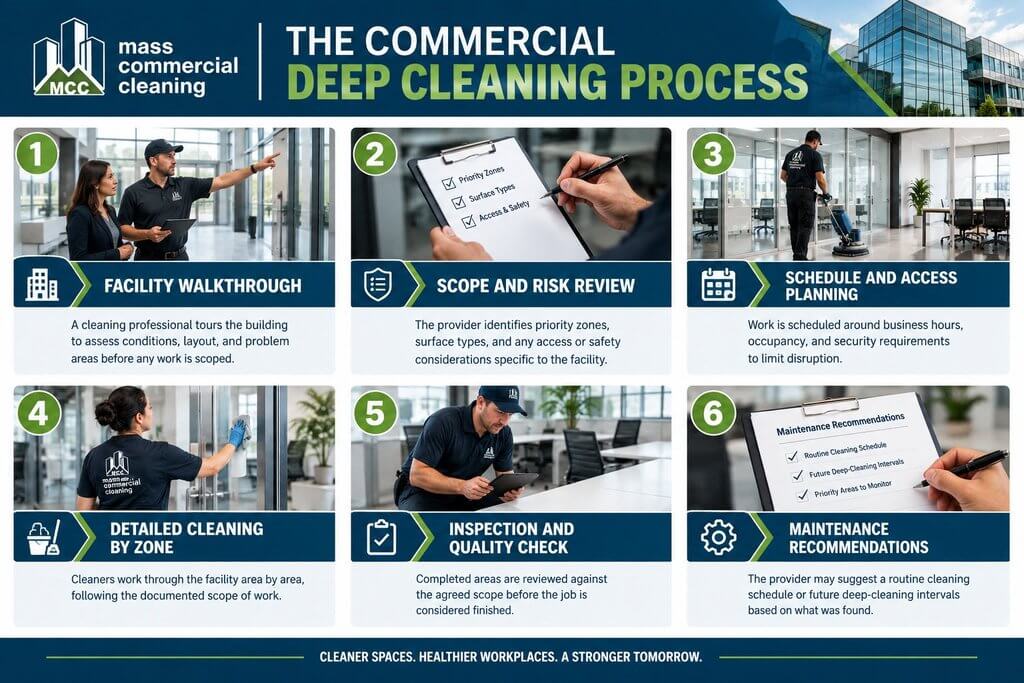
A professional deep clean typically starts with a walkthrough of the facility, not a fixed package applied automatically. During that walkthrough, a provider assesses which areas need attention first, what surfaces are involved, and what constraints exist around access and operating hours. From there, the scope of work is built around what the facility actually needs. The sections below describe areas that commonly get attention during a deep clean, though the specific tasks performed in any one building depend on that facility’s condition and priorities.
Entryways, Lobbies, and Customer-Facing Spaces
Cleaners typically assess entry mats, glass doors, reception furniture, and flooring near the entrance, since these areas collect the most tracked-in dirt and see the highest volume of first impressions. Tasks may include:
- detailed glass cleaning,
- mat cleaning or replacement coordination,
- baseboard wiping, and
- spot treatment of high-traffic flooring.
A common mistake is focusing only on the reception desk while leaving the floor near the entrance, which typically wears fastest, out of the plan.
Offices, Workstations, Break Rooms, and Shared Equipment
This includes desks, chairs, shared printers and copiers, phone equipment, and cubicle partitions. Cleaners may wipe down surfaces that accumulate dust and skin oils over time, clean under and around furniture, and address shared equipment that many employees touch throughout the day. Offices with dense workstation layouts often reveal buildup along partition edges and under keyboards that a nightly wipe-down doesn’t catch.
Restrooms / Washrooms
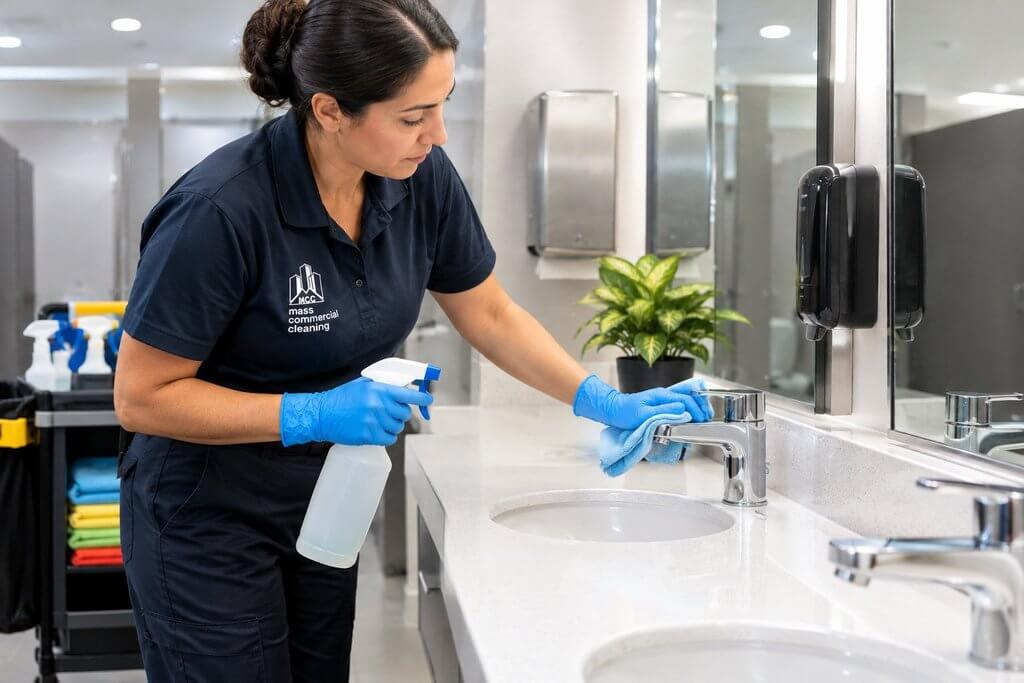
Restroom deep cleaning generally goes beyond daily disinfection of toilets and sinks. It may include detailed grout and tile cleaning, fixture descaling, partition wiping, vent cleaning, and attention to areas around floor drains. Restrooms are one of the areas where the gap between routine cleaning and a deep clean becomes most visible to occupants, since grime in grout lines and around fixture bases builds gradually and isn’t always removed by everyday cleaning.
Floors, Carpeting, Hard Surfaces, and Baseboards
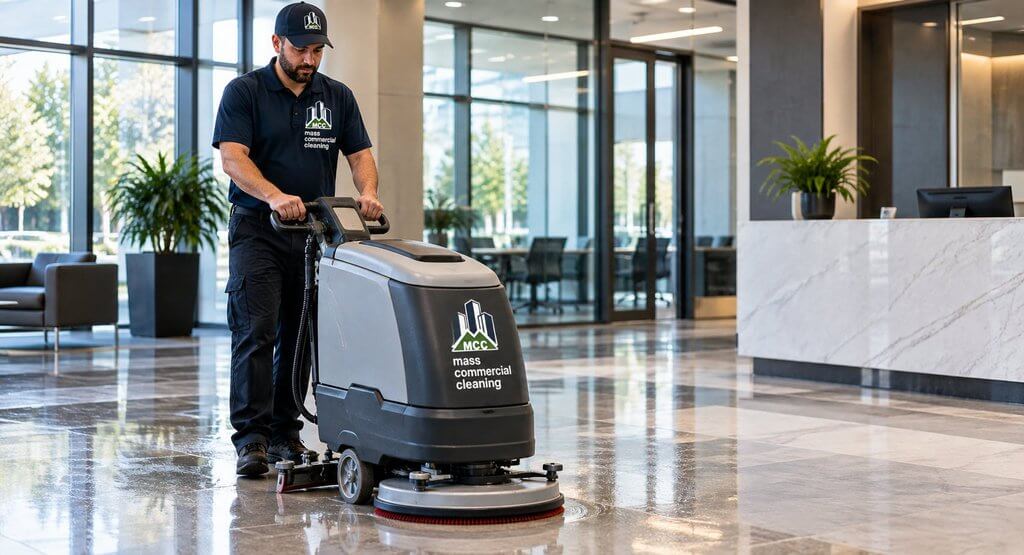
Floor care during a deep clean depends heavily on the surface material. Carpeted areas may receive extraction cleaning to remove soil embedded below the surface. Hard floors may be scrubbed, and baseboards along every wall are typically wiped to remove the dust line that accumulates at floor level. Floor care that’s deferred too long can shorten the useful life of flooring materials, which is one reason facility managers build it into a periodic maintenance cycle rather than waiting for visible damage.
High-Touch Surfaces and Frequently Used Fixtures
Door handles, light switches, elevator buttons, handrails, and shared equipment controls all qualify as high-touch surfaces. These points see far more contact than the surrounding walls or furniture, and a deep clean typically gives them dedicated attention rather than a quick pass during general wiping. Cleaning frequency for these areas may be adjusted based on facility traffic and, where appropriate, disinfection needs.
Warehouses, Industrial Spaces, and Back-of-House Areas
Industrial and warehouse environments accumulate dust, debris, and production residue differently than office space. A deep clean here may include detailed floor scrubbing, dust removal from shelving and overhead surfaces, and attention to break areas that staff use during shifts. Specialized work such as hazardous-material remediation or equipment decontamination generally falls outside standard deep cleaning and may require a separately scoped or separately qualified service.
Kitchens, Break Rooms, and Food-Adjacent Areas
Break room and kitchen-adjacent cleaning may include appliance exteriors and interiors, countertops, cabinet fronts, and floor areas around food preparation or consumption. These spaces tend to accumulate grease and food residue that daily wiping alone doesn’t fully remove, which makes them a frequent priority area during a scheduled deep clean.
Windows, Glass, Vents, Ledges, and Hard-to-Reach Areas
Interior glass, window ledges, vents, and high surfaces are easy to overlook during daily service because they aren’t at eye level and don’t always look dirty from a distance. A deep clean typically includes dusting and wiping these areas, along with interior glass cleaning where accessible. Exterior or high-elevation window work may require a separately scoped service depending on the building’s height and access requirements.
Why Commercial Deep Cleaning Matters for Businesses
A clean-looking facility and a genuinely well-maintained one aren’t always the same thing. Visible cleanliness refers to what occupants and visitors notice at a glance: clear floors, tidy surfaces, no obvious clutter. Hygiene refers to the underlying condition of surfaces, including buildup, soil, and microorganisms that aren’t visible without close inspection. A facility can look acceptable while still carrying significant buildup in restrooms, on floors, or around high-touch fixtures.
Commercial deep cleaning supports both. On the appearance side, it affects first impressions for customers, tenants, and job candidates walking through the door. On the maintenance side, it helps preserve flooring, carpet, and fixtures that wear faster when soil and grime are allowed to accumulate over long periods. The Centers for Disease Control and Prevention notes that spraying cleaning or disinfection products where it isn’t needed adds no real benefit, which is a useful reminder that deep cleaning should be targeted and purposeful rather than applied uniformly across every surface regardless of actual soil or risk.
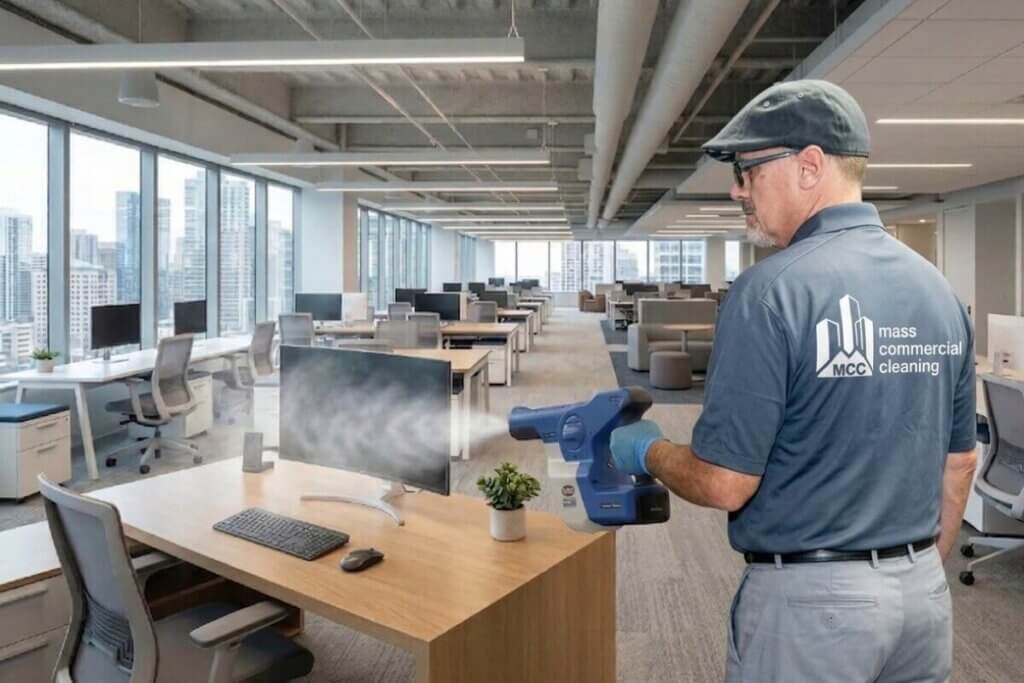
Cleaning and disinfecting aren’t interchangeable terms, and a deep clean should not be marketed as eliminating all germs or preventing illness. Soil removal generally needs to happen before a disinfectant can work as intended on a surface, since heavy dirt or grease can interfere with a product’s ability to reach and act on a surface. The CDC’s guidance on facility cleaning explains that disinfection is generally reserved for situations such as visible illness on facility surfaces, and that in high-traffic areas facilities may choose to clean more often or add disinfection on top of cleaning. Product effectiveness also depends on following the manufacturer’s label, including required dwell or contact time and any PPE guidance, which is why a professional provider trains staff on product-specific instructions rather than treating all cleaning chemicals the same way.
Illustrative example: Picture a mid-size professional office that has strong daily janitorial service but hasn’t scheduled a deep clean in over a year. Desks and common areas look fine at a glance. A closer look reveals dust buildup on vents, a dull sheen on carpeted walkways from ground-in soil, and grout lines in the restrooms that have darkened over time. None of this is dramatic enough to generate a complaint, but it gradually affects how the space feels to employees and visitors, and it puts extra wear on flooring that a periodic deep clean could have helped prevent. This is a hypothetical scenario meant to illustrate a common pattern, not a specific client case.
Signs Your Facility Needs Commercial Deep Cleaning
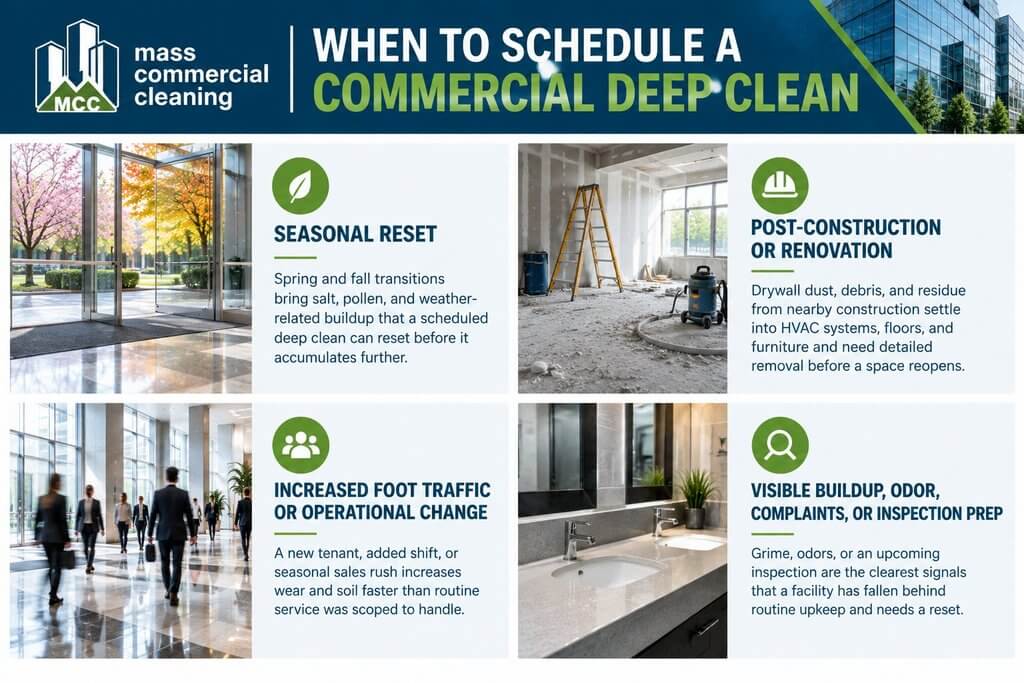
Facility managers often wait for a complaint before scheduling anything beyond routine service. A more useful approach is watching for physical signs that buildup has reached the point where routine cleaning alone won’t resolve it. Common signs include:
- Persistent odors that don’t go away after routine cleaning
- Grimy grout or discolored restroom fixtures
- Visible buildup or dullness on flooring
- Stained or matted carpeting, particularly in high-traffic paths
- Dust collecting on vents, ledges, or other high surfaces
- A break room or kitchen area that looks neglected despite daily wiping
- Sticky or grimy high-touch surfaces such as handles and switches
- Complaints or comments from staff or visitors about cleanliness
- An upcoming move, renovation, seasonal reset, or inspection
- A noticeable increase in foot traffic or a change in how the space is used
- A gap or lapse in regular janitorial service
- Visible baseboard buildup that daily mopping doesn’t touch
Do Not Wait for a Complaint
Waiting for a customer or employee complaint means the facility has already fallen behind on cleanliness, and by that point occupants have already noticed. A more reliable approach is scheduling commercial deep cleaning based on actual facility conditions, traffic patterns, and risk factors specific to the space. Facilities with heavy foot traffic, food service, or healthcare-adjacent activity generally need more frequent attention than a low-traffic office suite. Tracking conditions proactively, rather than reactively, keeps a facility ahead of the problem instead of catching up to it.
How Often Should a Business Schedule Commercial Deep Cleaning?
There’s no single schedule that fits every business. How often a facility should schedule commercial deep cleaning depends on several factors:
- occupancy levels,
- customer traffic,
- the type of facility,
- contamination or spill risk,
- flooring materials,
- seasonal weather (which affects how much dirt and salt get tracked in),
- production activity, and
- how strong the existing routine janitorial program already is.
Consequently, a retail space with constant foot traffic has very different needs than a low-occupancy professional office.
Suggested Commercial Deep Cleaning Triggers by Facility Type
| Facility Type | Common Deep-Cleaning Priorities | Typical Scheduling Triggers |
|---|---|---|
| Office | Carpets, workstations, break rooms, vents | Seasonal reset, staff turnover, visible wear |
| Medical or healthcare setting | High-touch surfaces, floors, waiting areas | Facility-specific protocol review; should assess needs with a qualified provider |
| School or educational facility | Classrooms, cafeterias, restrooms, gyms | Between semesters, before/after breaks, seasonal buildup |
| Warehouse or distribution center | Floors, shelving, break areas, loading zones | Increased throughput, dust accumulation, safety walkthroughs |
| Industrial facility | Floors, equipment-adjacent areas, break rooms | Production changes, scheduled maintenance windows |
| Retail or customer-facing location | Entryways, floors, fitting rooms, restrooms | Seasonal traffic increases, holiday periods, visible wear |
| Financial or professional-services office | Lobbies, workstations, restrooms, glass | Client-facing events, seasonal reset, visible buildup |
These triggers are meant as a starting point, not a fixed rule. A medical or healthcare-adjacent facility in particular should assess its own protocols carefully, since requirements vary by setting and ordinary commercial cleaning is not a substitute for a facility’s infection-control program. Mass Commercial Cleaning can evaluate a facility’s specific traffic, layout, and operating schedule and build a deep-cleaning plan around those factors rather than applying a generic interval.
Why Hire Professionals Instead of Adding Deep Cleaning to In-House Duties?
Many facilities already have staff who handle light cleaning tasks between janitorial visits. The question is whether adding an intensive deep clean to those same duties makes operational sense. It’s a fair tradeoff to weigh, and it isn’t a reflection on in-house staff, who are often already stretched across their primary responsibilities.
Professional deep cleaning requires dedicated labor hours that in-house teams frequently can’t spare without falling behind elsewhere. It also requires specific equipment, such as extraction machines or floor scrubbers, that most facilities don’t keep on hand for occasional use. Product knowledge matters too. For example, you need an understanding about which cleaning agents are compatible with which surfaces, and following label instructions for dwell time and safety precautions. This takes training that a general facilities team may not have.
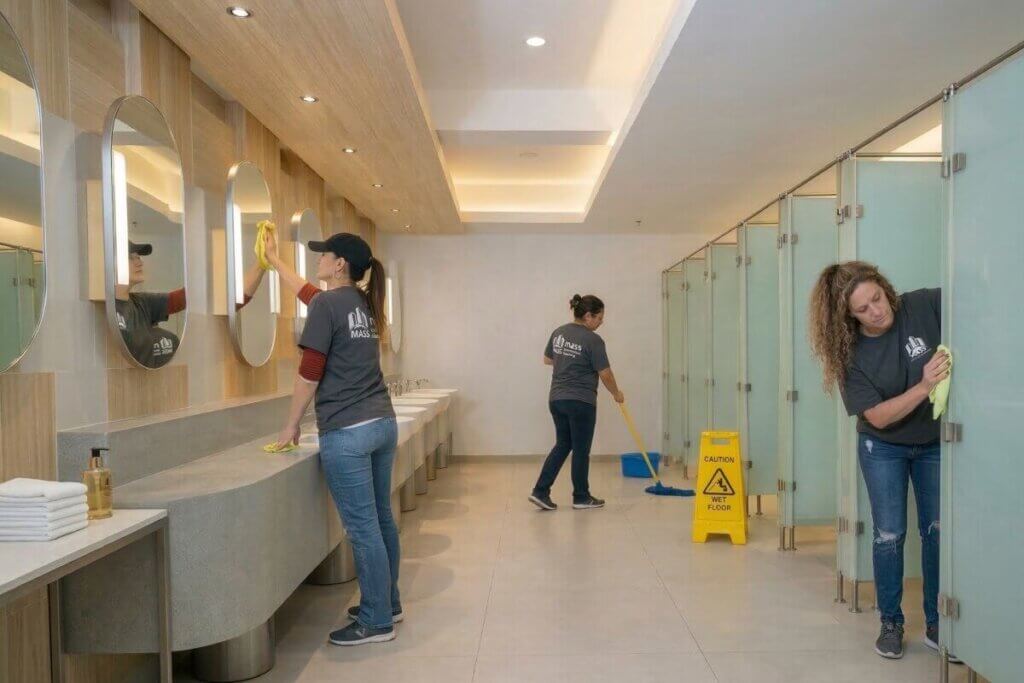
A professional cleaning company can provide a documented process that is often difficult to replicate internally. That process should define the scope of work and set out a schedule that accounts for access, timing, and disruption. It should also include a quality check at the end to confirm the work matches what was agreed.
As a result, the cleaning team has a clear process to follow from start to finish. This level of accountability can be difficult to maintain when an internal team is already managing a full workload.
Mistake to avoid: Giving an intensive deep clean to already-busy employees can lead to inconsistent results. They may rush through the work so they can return to their primary responsibilities. At the same time, their regular duties may be delayed or overlooked. As a result, neither job gets the attention it needs. Scheduling deep cleaning as a dedicated service avoids this trade-off. The cleaning gets the time and attention it requires, while employees can stay focused on their regular responsibilities.
Why Choose an Employee-Owned Cleaning Company Instead of a National Franchise?
Both employee-owned local providers and national franchises can deliver quality commercial cleaning, and the right choice depends on what a facility manager values most. That said, an employee-owned structure offers some potential advantages worth considering. Staff who hold an ownership stake in the company have a direct interest in the quality of the work and the satisfaction of the clients they serve. Local providers are also often easier to reach directly, since communication doesn’t have to travel through multiple layers of a corporate franchise structure.
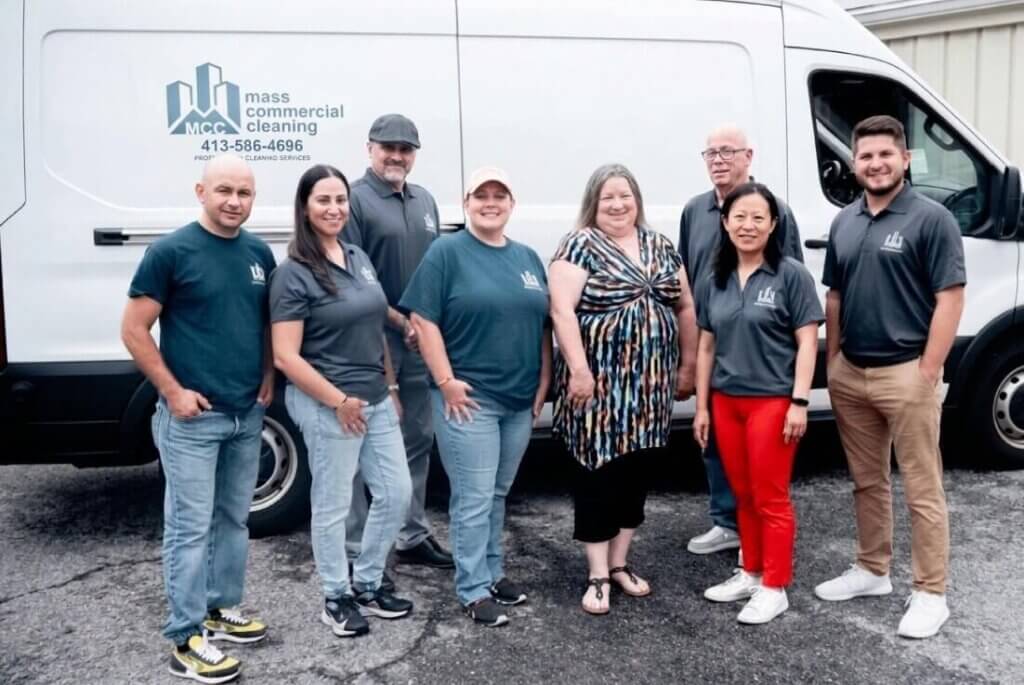
Mass Commercial Cleaning became an employee-owned company in 2021, following the retirement of its founding owners. The company has operated in Massachusetts since 1989 and now includes more than 120 trained cleaning professionals serving businesses across Worcester, Springfield, and the surrounding communities. As an employee-owned commercial cleaning company, every team member holds a stake in the outcome of the work performed in each client’s facility.
Employee-Owned Commercial Cleaning Company vs. National Franchise
| Consideration | Employee-owned local provider | National franchise model |
| Accountability | Staff have a direct ownership stake in outcomes | Accountability structure varies by franchise owner |
| Communication | Often direct access to local management | May route through corporate or regional layers |
| Team continuity | Local teams tend to have long-term familiarity with client facilities | Staffing and territory assignments can vary |
| Local decision-making | Decisions made close to the client relationship | Decisions may require corporate approval |
| Flexibility | Can often adjust scope or schedule quickly | May be constrained by standardized franchise procedures |
| Quality oversight | Direct oversight tied to company ownership | Oversight structure depends on the individual franchise |
| Relationship management | Built around long-term local client relationships | Varies widely by location and ownership |
Note: Service quality varies by provider. Ask any prospective cleaning company how it staffs, supervises, inspects, and communicates about your facility.
How Mass Commercial Cleaning Builds a Deep Cleaning Plan
Mass Commercial Cleaning approaches every deep-cleaning project with a facility-specific process rather than a standardized package. It begins with a walkthrough of the space to understand layout, surfaces, and current condition. From there, the team identifies facility priorities based on what the walkthrough reveals, whether that’s restroom buildup, worn flooring, or neglected high-touch areas.
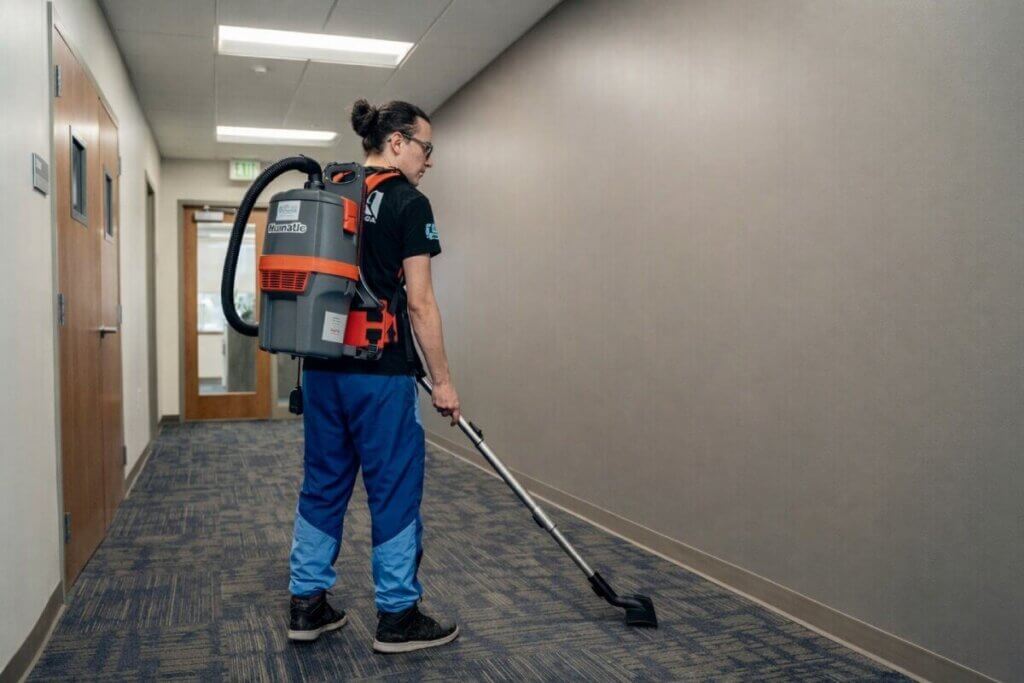
Next comes a surface and floor assessment, since different materials call for different tools and products. That assessment feeds into a defined scope of work outlining exactly which areas and tasks are included. A schedule and access plan is built around the facility’s operating hours and security requirements, so cleaning happens with minimal disruption to staff and customers. Staffing and equipment are matched to the scope, and clear quality-control expectations are set before work begins so the facility manager knows what a completed job should look like.
Once the work is finished, Mass Commercial Cleaning can offer ongoing maintenance recommendations to help the facility maintain results between deep cleans. As a Massachusetts-based commercial cleaning company, the team draws on decades of experience across offices, medical and healthcare facilities, schools, warehouses, banks and financial facilities, and industrial environments to build a plan suited to each type of space. Businesses can review the company’s commercial cleaning service areas to confirm coverage for their specific location.
Commercial Deep Cleaning Checklist for Facility Managers
Before hiring a provider, facility managers can use this checklist to prepare for the conversation and make sure nothing important gets left out of the scope:
- Define your priority areas (restrooms, floors, high-touch surfaces, etc.)
- Identify operating constraints, including hours and occupancy patterns
- Confirm access and security requirements for after-hours or weekend work
- List surface materials and any known problem areas
- Document recent spills, damage, or special conditions
- Ask the provider about product and surface compatibility
- Clarify exactly what is included and excluded in the scope of work
- Set clear inspection standards for completed work
- Schedule work around staff, visitors, or production activity
- Confirm how disruption will be minimized during the cleaning
- Ask how the provider trains and supervises its cleaning staff
- Request a plan for ongoing or follow-up maintenance
- Confirm communication procedures if an issue comes up mid-project
- Review insurance and liability coverage with the provider directly
- Set a realistic timeline for the completed work
Save this list and use it before your next deep-cleaning conversation with any provider, not just for a first-time hire.
Frequently Asked Questions About Commercial Deep Cleaning
What is included in commercial deep cleaning?
Commercial deep cleaning generally includes detailed attention to restrooms, floors, high-touch surfaces, and hard-to-reach areas like vents and baseboards. The exact scope varies by facility and is typically defined after a walkthrough and assessment of the space.
How is commercial deep cleaning different from janitorial cleaning?
Janitorial cleaning maintains daily appearance through routine tasks like trash removal and surface wiping. Commercial deep cleaning works on a longer cycle, targeting buildup in areas that routine visits don’t typically reach, using more detailed methods and specialized equipment.
How often should a business schedule commercial deep cleaning?
Frequency depends on occupancy, traffic, facility type, and the strength of existing janitorial service. Many businesses schedule deep cleaning seasonally or a few times a year, though high-traffic or production facilities may benefit from more frequent scheduling.
Does commercial deep cleaning include disinfection?
Disinfection may be part of a deep clean depending on the facility’s needs, but it isn’t automatic. Soil removal generally comes first, and disinfection is typically applied to high-touch surfaces or in response to specific facility conditions and protocols.
How long does commercial deep cleaning take?
Duration depends on facility size, condition, and scope of work. A single office suite may take a matter of hours, while a larger facility with more priority areas can take longer. A walkthrough helps the provider estimate timing accurately.
Why choose an employee-owned commercial cleaning company?
Employee-owned companies give staff a direct stake in client satisfaction and work quality. This structure can support stronger accountability and consistency, though service quality still depends on the specific provider’s training, supervision, and communication practices.
Schedule Commercial Deep Cleaning With Mass Commercial Cleaning
Every facility accumulates buildup differently, which is why a commercial deep cleaning plan should reflect your building’s actual traffic, materials, priorities, and operating schedule rather than a generic checklist. Whether you’re managing an office, a medical or educational facility, a warehouse, or a financial services location, the right plan starts with understanding what your space actually needs.
Mass Commercial Cleaning can walk through your facility, assess current conditions, and propose a cleaning plan built around your priorities and your schedule. As an employee-owned company serving businesses across Massachusetts, the team brings decades of hands-on experience to facilities of every size.
Contact Mass Commercial Cleaning online or by calling 413-586-4696 to discuss a customized deep-cleaning assessment for your facility.
