
The Industrial Safety Imperative in Massachusetts
Industrial facility managers operating across Hampden, Hampshire, Worcester, and Middlesex Counties face continuous pressure to maintain productive, safe, and compliant work environments. Manufacturing plants in Springfield, logistics distribution hubs in Worcester, and high-tech assembly facilities in Middlesex County run heavy equipment, forklift fleets, and multi-shift workforces around the clock. Within these demanding environments, concrete and epoxy floors endure relentless mechanical friction, chemical spills, airborne particulate settling, and tracked-in moisture. When facility teams treat surface sanitation as an afterthought, smooth floor finishes quickly become major workplace hazards.
Slip-and-fall accidents represent one of the leading causes of preventable worker injuries and workers’ compensation claims in industrial settings. According to standards established by the Occupational Safety and Health Administration (OSHA) and the Massachusetts Department of Labor Standards, employers must maintain clean, dry, and slip-resistant walking surfaces.
Achieving this level of safety requires more than occasional sweeping or basic damp mopping. Facilities require a structured approach to routine floor care paired with periodic, restorative floor refinishing to preserve structural floor finishes and eliminate hazardous traction loss.
Understanding the direct connection between industrial floor maintenance and workplace safety allows facility directors to protect their workforce while lowering operational risk. This comprehensive guide examines the friction mechanics behind slip hazards, details the technical steps involved in complete floor care, and explains why partnering with an employee-owned cleaning specialist offers superior reliability compared to national franchise models.
The Physics of Slip Hazards and Industrial Floor Degradation
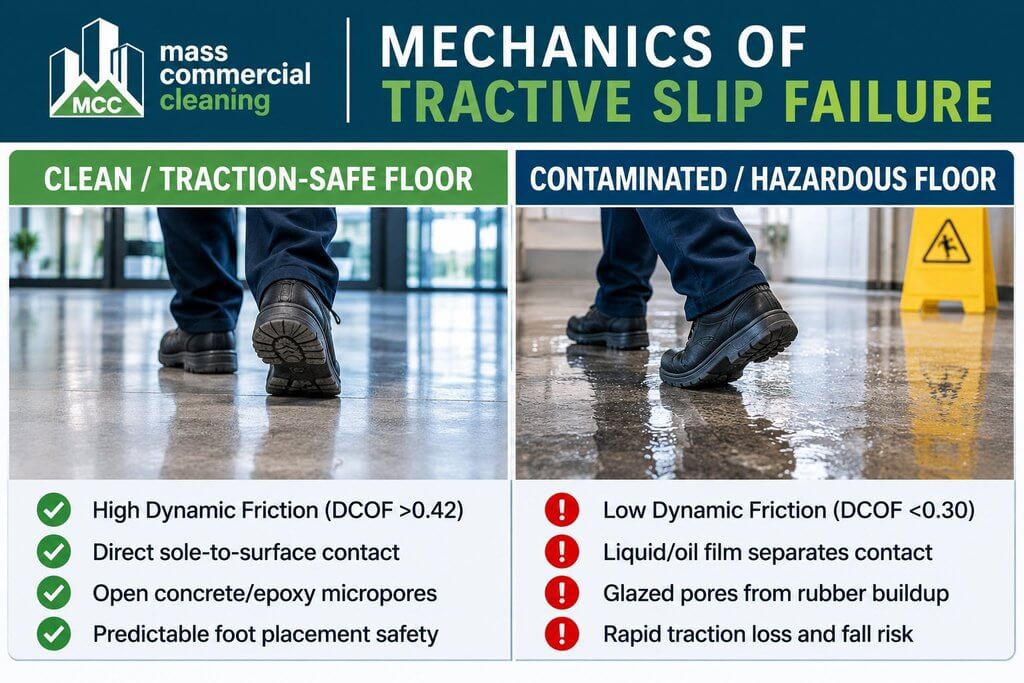
Preventing workplace slips requires understanding how liquid films, particulate buildup, and mechanical wear alter the surface friction of industrial floors. The safety of a walking surface depends on its dynamic coefficient of friction (DCOF), which measures the force required to keep an object sliding across a wet or dry surface. The National Floor Safety Institute (NFSI) and ANSI standard A326.3 establish that wet walking surfaces should maintain a minimum DCOF of 0.42 to provide adequate traction for standard footwear.
When industrial floors accumulate fine particulate matter, ambient moisture, or airborne coolant mists, a microscopic lubricating layer forms between the shoe sole and the floor surface. This phenomenon, known as hydrodynamic planning, reduces friction instantly and causes the foot to slip. In high-traffic manufacturing corridors, heavy forklift tires deposit micro-layers of rubber onto polished concrete or epoxy coatings. Over time, these rubber deposits seal off the microscopic pores of the floor, creating smooth, glossy spots that lose traction whenever ambient humidity rises or liquid drips occur.
The financial impact of neglecting surface friction is substantial. A single slip-and-fall accident in a Massachusetts manufacturing facility can result in direct medical costs, disability compensation, OSHA citations, temporary staffing expenses, and increased insurance premiums. Consistent industrial floor maintenance mitigates these financial risks by systematically stripping away oil films, extracting embedded particulates, and restoring the natural slip resistance of the flooring material.
Industrial Flooring Surface Friction and Contaminant Risk Matrix
| Flooring Type | Common Contaminants | Slip Risk Level | Primary Traction Failure Mechanism | Recommended Maintenance Protocol |
| Sealed Concrete | Hydraulic fluid, fine dust, water | High | Fine particulate glaze over smooth sealer | Daily auto-scrubbing with neutral cleaner |
| Epoxy Coating | Cutting oils, coolants, grease | Severe | Hydrodynamic liquid film creation | High-pressure degreasing and wet recovery |
| Vinyl Composition Tile (VCT) | Pallet dust, tracked ice melt, grit | Moderate | Wax finish erosion and salt crystallization | Periodic stripping, sealing, and recoating |
| Polished Concrete | Dry ambient dust, tire marks | Medium | Rubber buildup filling microscopic pores | Mechanical burnishing and deep extraction |
What Complete Industrial Floor Maintenance Involves
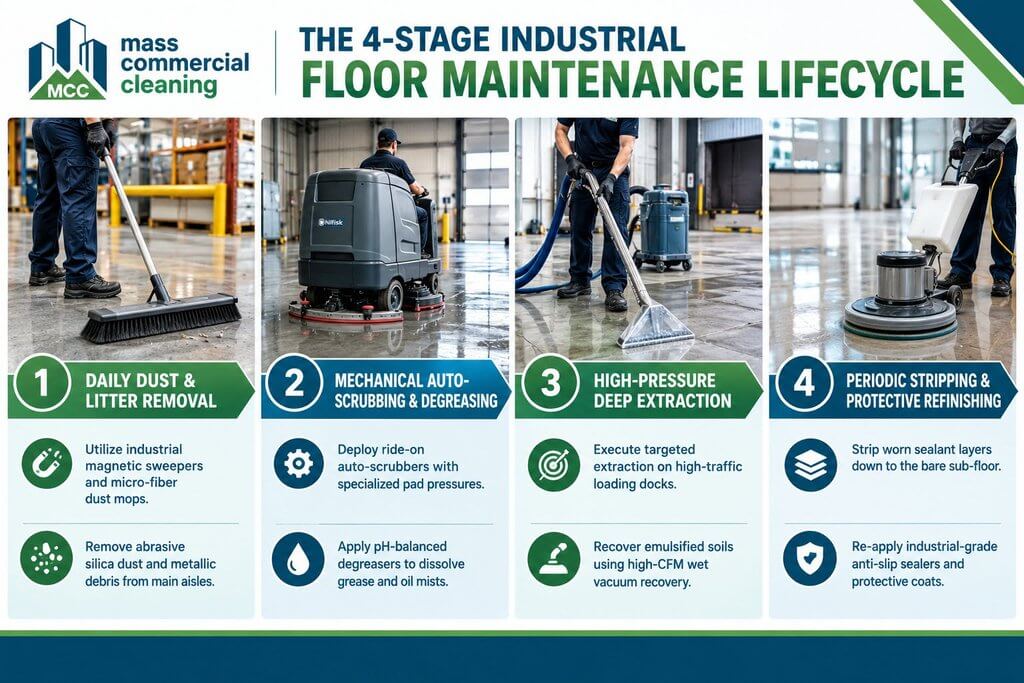
Proper floor care in a manufacturing or logistics setting involves a multi-stage operational framework. Facility managers who rely solely on static sweeping routines fail to address the sub-surface soil accumulation that degrades floor traction. Complete industrial floor maintenance combines daily maintenance, deep mechanical scrubbing, chemical degreasing, and surface restoration.
Stage 1: Particulate Control and Pre-Sweeping
Before any wet cleaning takes place, technicians must eliminate dry abrasive soils. In warehouses across Worcester and Middlesex Counties, airborne cardboard dust and ambient silica grit act like small ball bearings underfoot. Sweeping with industrial magnetic collectors and micro-fiber dust catchment systems removes dry particulate before auto-scrubbers pass over the surface, preventing the creation of abrasive slurry that scratches floor sealants.
Stage 2: Mechanical Auto-Scrubbing and Chemical Emulsification
Auto-scrubbing forms the foundation of daily floor hygiene. Industrial scrubbers apply regulated down-pressure through cylindrical brushes or pad drivers while dispensing calibrated cleaning solutions. The choice of cleaning chemistry depends directly on the soil profile. Vegetable oils and animal fats in food processing plants require alkaline degreasers, whereas petroleum-based hydraulic fluids require specialized solvent-emulsifying cleaners that break down complex hydrocarbon chains without damaging underlying epoxy or concrete.
Expert Observation: Chemical Dwell Time in Machinery Bays
A frequent mistake made by untrained custodial workers is spraying a chemical cleaner and scrubbing it off immediately. To break down dense hydrocarbon chains in hydraulic fluid or cutting mists, the emulsifying agent requires a three-to-five-minute dwell time on the concrete surface before mechanical scrubbing begins. Rushing this step leaves an oily residue behind that lowers surface traction.
Stage 3: Liquid Recovery and Vacuum Extraction
Cleaning a floor is only effective if the suspended soil and chemical solution are completely removed. Modern auto-scrubbers feature parabolic squeegee assemblies paired with heavy-duty vacuum motors that capture liquid runoff in a single pass. Leaving damp streaks or chemical residue behind creates immediate slip hazards as the water evaporates and leaves concentrated soap films on the floor.
Stage 4: Restorative Floor Refinishing
Over time, high-volume forklift traffic wears down protective sealants. Restorative maintenance involves stripping away old or damaged protective finishes, neutralizing the bare concrete or tile, and applying multiple thin coats of slip-resistant industrial floor finish. High-solids sealers embedded with micro-polypropylene additives increase the static and dynamic coefficients of friction, providing long-lasting slip resistance even under wet conditions.
The Employee-Owned Advantage: Why Local Ownership Beats National Franchises
When selecting a commercial cleaning company for specialized commercial floor care, facility directors must evaluate the structural business model of the cleaning company. The commercial cleaning industry is split between two primary structures: national franchise networks and locally rooted, employee-owned service providers. For industrial facilities where safety compliance and operational consistency are paramount, the employee-owned model provides distinct advantages.
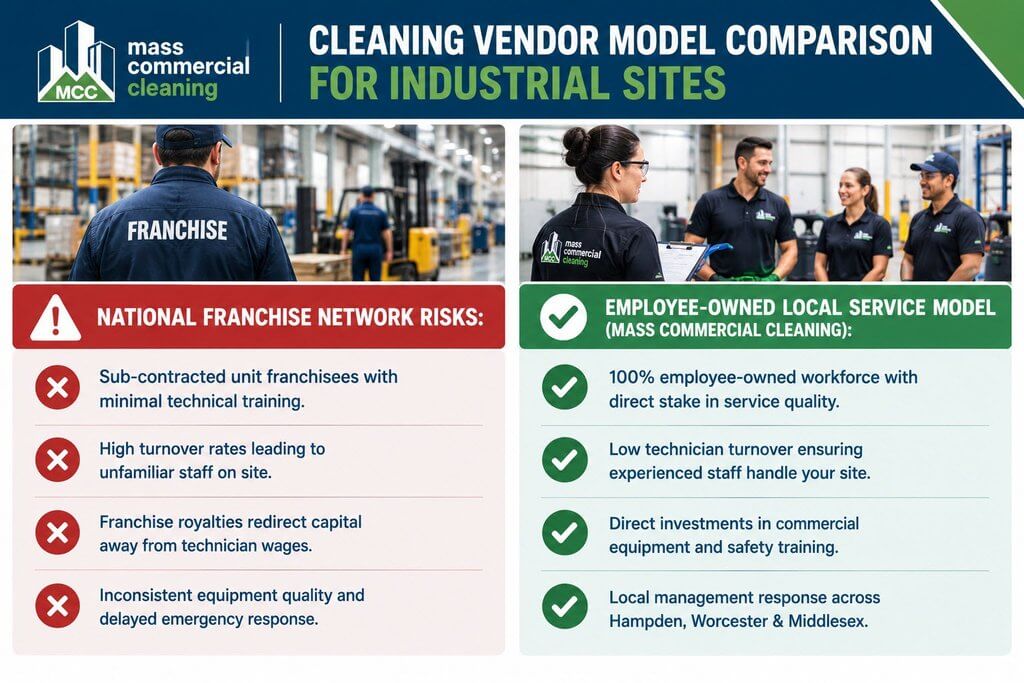
National franchises operate by selling individual cleaning routes or accounts to unit franchisees who often lack formal technical training in industrial floor chemistry, OSHA standards, and heavy equipment operation. Because unit franchisees pay significant monthly royalties and administrative fees back to corporate headquarters, worker wages are compressed, leading to high staff turnover. In an industrial plant where chemical handling and machinery clearance require strict safety awareness, rotating unfamiliar workers through your facility increases operational risk.
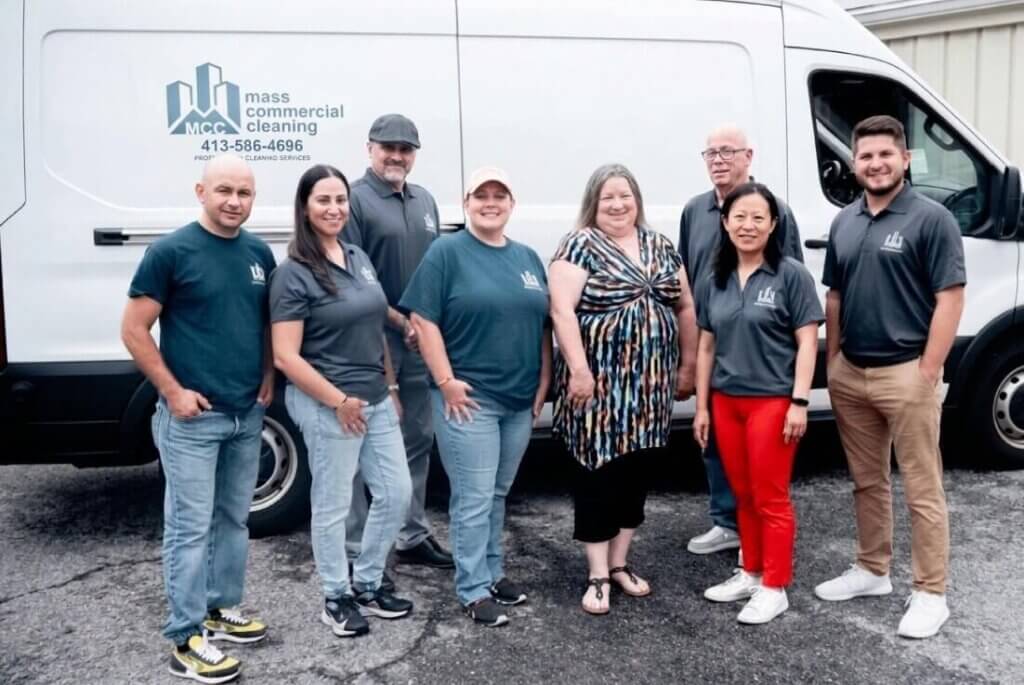
In contrast, Mass Commercial Cleaning operates as a fully employee-owned commercial cleaning company. Every cleaning technician on site holds an ownership stake in the business. This structure creates a culture of personal accountability and professional pride. When technicians are co-owners, they take meticulous care of client facilities, adhere strictly to safety protocols, and maintain long-term working relationships with facility managers.
Structural Comparison: National Franchises vs. Employee-Owned Mass Commercial Cleaning
| Performance Metric | National Franchise Networks | Employee-Owned Mass Commercial Cleaning |
| Workforce Ownership | Sub-contracted unit franchisees | 100% Employee-Owned (ESOP structure) |
| Technician Turnover Rate | High (often exceeding 100% annually) | Exceptionally Low (long-term career technicians) |
| Quality Control Oversight | Distance management via regional brokers | Direct, local ownership supervision on every shift |
| Industrial Training Standards | Basic residential or retail training | Specialized industrial floor chemistry and machinery care |
| Local Response Flexibility | Rigid franchisee territorial boundaries | Agility across all Massachusetts service areas |
| Safety Protocol Adherence | Inconsistent across sub-contractor teams | Strict OSHA, TOSHA, and site-specific safety compliance |
Choosing an employee-owned partner ensures that the cleaning professionals managing your floors understand the technical demands of industrial floor maintenance. Their vested interest in client retention translates directly into cleaner, safer, and more consistent facility conditions.
Technical Execution Protocols and Hazard Containment
Executing floor maintenance in active manufacturing plants requires precise planning to avoid disrupting production schedules or creating temporary safety bottlenecks. Technicians must establish clear containment boundaries, follow chemical safety guidelines, and execute structured cleaning sequences.
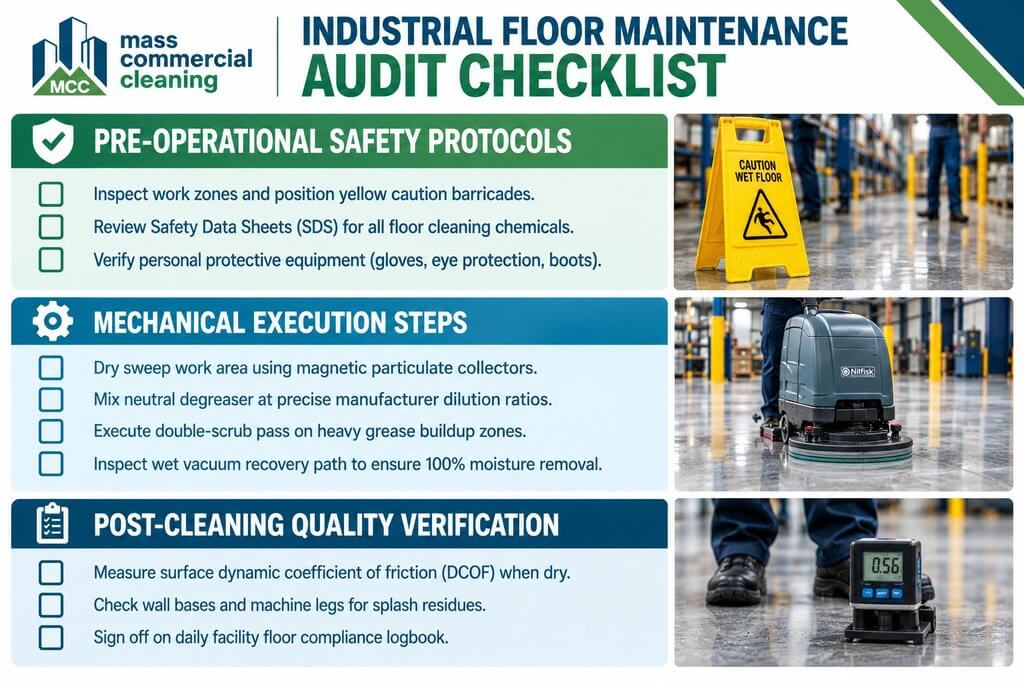
Chemical Dilution Precision and Residue Control
A common error made by untrained janitorial staff is over-concentrating cleaning chemicals under the false assumption that more soap equals a cleaner floor. Excess chemical concentrate leaves a sticky surfactant film on concrete and tile surfaces. As moisture evaporates, this detergent residue acts as a dirt magnet, rapidly darkening the floor and creating a slick surface whenever liquid spills occur.
Professional technicians utilize automated chemical dilution dispensers to guarantee exact water-to-chemical ratios. Neutral pH cleaners (pH 7.0 to 8.5) are specified for daily auto-scrubbing on sealed concrete and epoxy surfaces, while specialized alkaline cleaners (pH 10.0 to 11.5) are reserved for heavy oil emulsification in designated machinery bays.
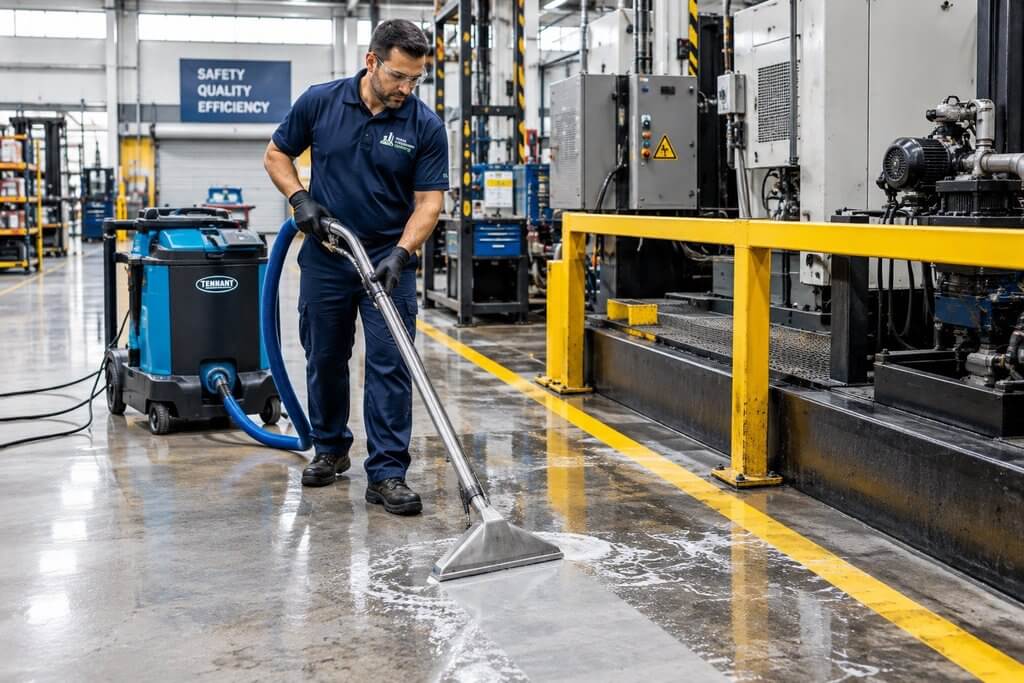
Case Scenario: Precision Degreasing in a Worcester Machining Plant
A 45,000-square-foot precision machining facility in Worcester County experienced recurring slip incidents near its CNC equipment bays. In-house janitorial workers had been applying standard degreasers at double the recommended concentration, leaving a slippery detergent film behind. Professional commercial cleaning staff implemented a neutral pH extraction pass followed by a dual-action mechanical scrubbing routine. Surface friction testing confirmed that the wet DCOF rose from a hazardous 0.31 to a safe 0.48 within 48 hours, completely eliminating slip reports along the production aisle.
High-Traffic Transition Zone Management
Transition zones, areas where concrete production floors meet carpeted office corridors or vinyl breakroom tiles, present high slip risks. Forklifts and foot traffic drag oil, water, and metal shavings directly across these transition thresholds. Correcting this requires installing heavy-duty, rubber-backed walk-off matting systems extending at least 15 to 20 feet from exterior doors and plant entrances, combined with daily extraction of the matting fibers.
When Should Your Facility Hire Commercial Cleaning Professionals?
Determining when to transition from in-house custodial care to professional commercial cleaning services is a critical operational decision. Small facilities may initially attempt to manage floor care using internal maintenance workers, but as plant footprints expand and production schedules intensify, in-house teams often lack the time, machinery, and specialized knowledge required to maintain slip-resistant floor standards.
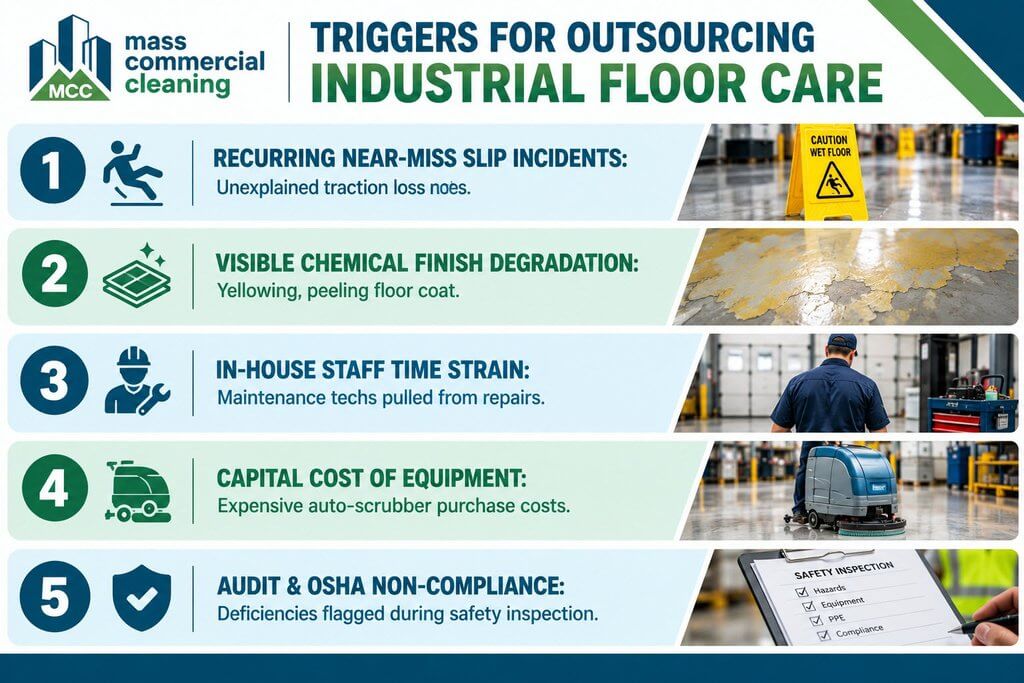
If your facility experiences any of the following operational signals, it is time to partner with an accredited cleaning specialist:
- Rising Slip-and-Fall Near-Misses: When environmental health and safety logs indicate an increase in near-miss reports along main walkways, floor friction levels have dropped below safe operating thresholds.
- Visible Oil Haze or Rubber Glaze: When concrete or epoxy floors develop a persistent dark sheen that remains after standard sweeping, embedded soils require high-pressure mechanical scrubbing.
- Internal Equipment Downtime: Industrial auto-scrubbers and floor extractors require ongoing mechanical maintenance. When in-house equipment sits broken, floor care schedules collapse, allowing hazards to accumulate.
- Maintenance Staff Overburden: Pulling skilled industrial maintenance mechanics away from machine repairs to sweep or mop floors is an inefficient use of labor capital.
- Expanding Facility Footprint: Opening new distribution bays or expanding production lines across Massachusetts requires scaled, reliable cleaning support that adapts to shifting production volumes.
Integrating professional floor care with comprehensive janitorial services ensures every square foot of your plant, from loading docks to administrative offices, remains clean, compliant, and safe.
Frequently Asked Questions
How frequently should industrial floors undergo deep mechanical scrubbing?
High-traffic manufacturing aisles and loading docks require daily auto-scrubbing, while low-traffic storage bays benefit from deep mechanical scrubbing two to three times weekly, depending on soil volume and environmental conditions.
What is the ideal dynamic coefficient of friction for industrial floors?
According to ANSI A326.3 and NFSI standards, wet industrial walking surfaces should maintain a minimum dynamic coefficient of friction (DCOF) of 0.42 to ensure adequate slip resistance for standard safety footwear.
Why are employee-owned cleaning companies more reliable for industrial facilities?
Employee-owned companies feature lower staff turnover, higher personal accountability, and dedicated co-owner technicians who take direct pride in maintaining safety compliance, resulting in consistent, high-quality facility care.
Can improper cleaning chemicals increase slip and fall risks on concrete floors?
Yes. Using over-concentrated detergents or improper chemicals leaves a sticky surfactant residue that traps dirt and creates an extremely slick film whenever ambient moisture or liquid drips occur.
Partner with Massachusetts’ Premier Employee-Owned Cleaning Team
Protecting your industrial facility, workforce, and operational budget requires a specialized commercial cleaning partner that understands the mechanics of floor safety.
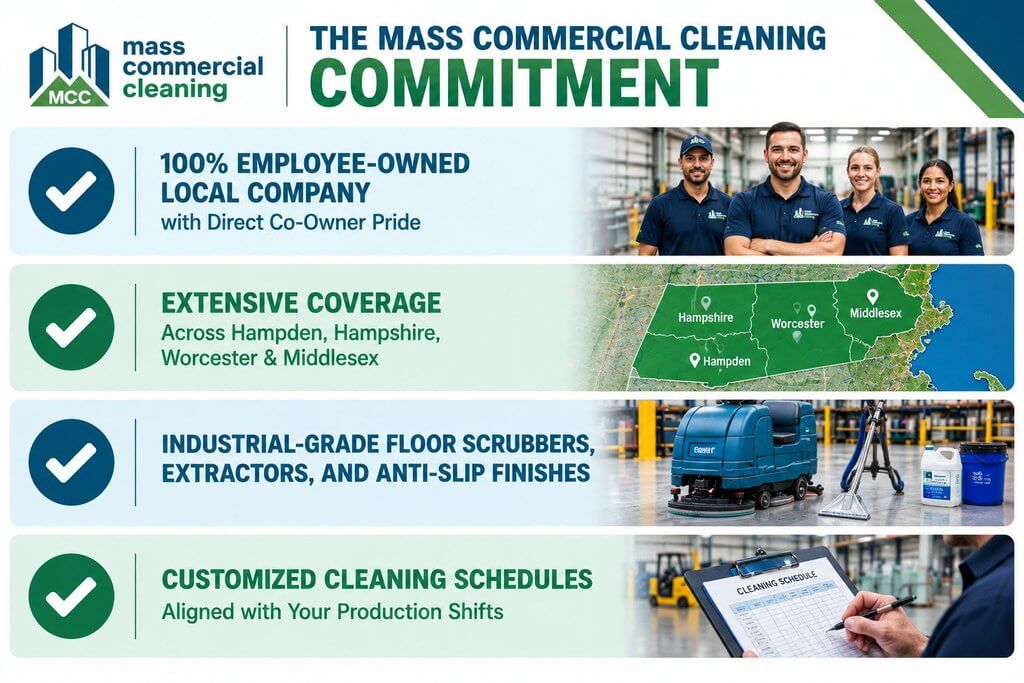
Whether you manage an industrial manufacturing plant in Springfield, a distribution hub in Worcester, a medical device facility in Middlesex County, or an industrial warehouse in Hampshire County, Mass Commercial Cleaning delivers tailored floor maintenance solutions engineered to eliminate slip risks and keep your operations moving forward. Explore our regional coverage across our commercial cleaning service areas to learn how our local teams support facility managers throughout the Commonwealth.
Ready to eliminate floor safety hazards and upgrade your janitorial standards?
Contact the industrial cleaning experts at Mass Commercial Cleaning today online or by calling 413-586-4696 to schedule an on-site floor assessment. You’ll receive a clear, transparent proposal tailored precisely to your facility layout and operational schedule.
