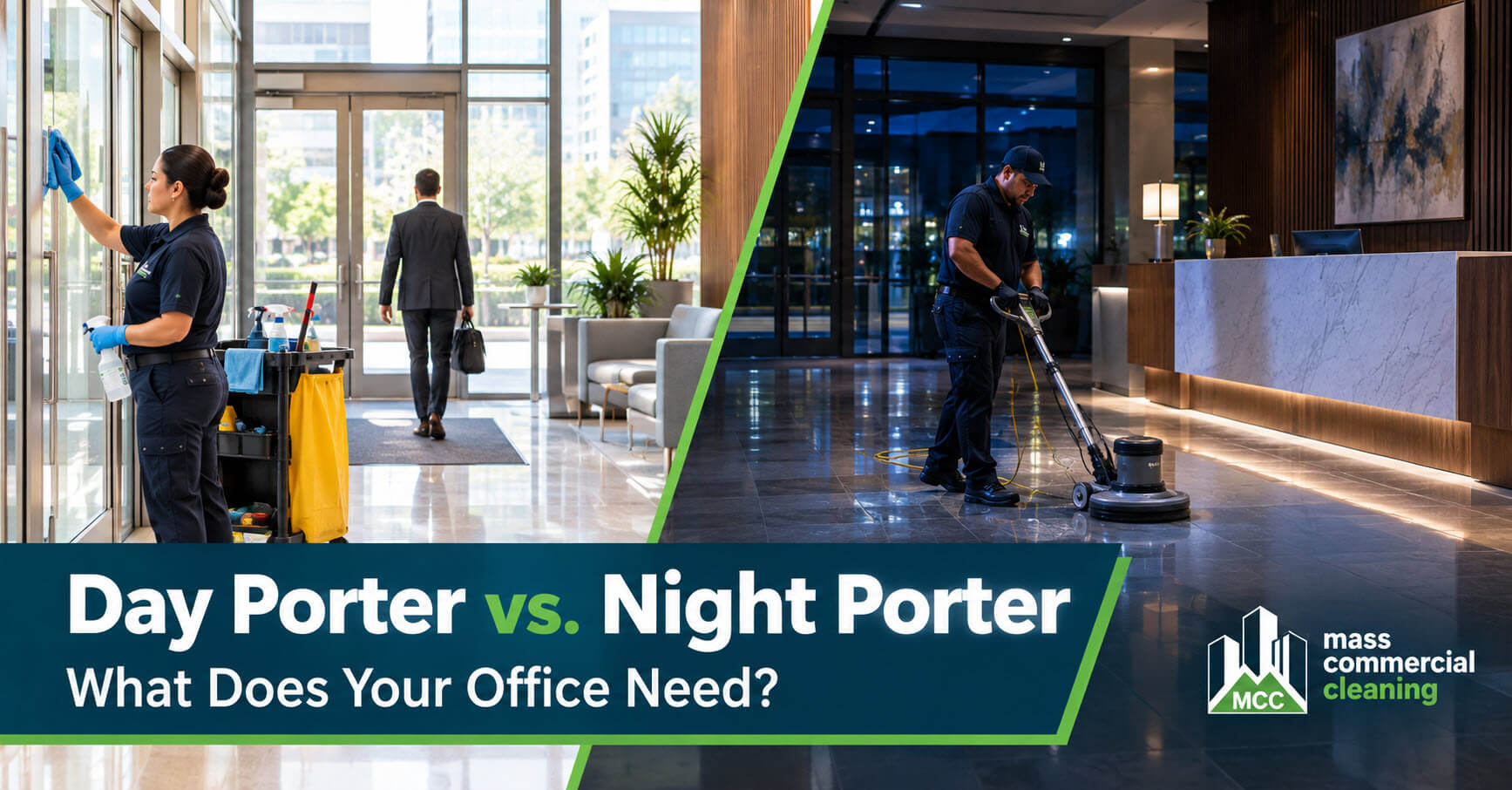
Every facility leader eventually faces the same scheduling question. Does the building need someone on site during business hours to keep lobbies, restrooms, and meeting rooms presentable? Does it need a crew that works after everyone leaves? Or does it need both? The answer affects your cleaning budget, your tenant experience, and the first impression every visitor gets.
Treating day porter vs night cleaning as a contest misses the point. Neither service wins on its own. The better question is which combination fits your building’s foot traffic, tenant expectations, security needs, and budget. A quiet single-tenant office may do well with nightly cleaning alone. A busy corporate lobby with shared restrooms and a full meeting calendar probably needs more.
Mass Commercial Cleaning provides both day porter services and night porter services for commercial facilities, so we see how each model performs in real buildings. In this article, we compare the two approaches, explains the costs and operational impact, and helps you choose the right cleaning schedule for your facility.
The Evolution of Workplace Hygiene Schedules
Not long ago, an office could pass inspection if it looked good at 8 a.m. Someone cleaned overnight, the lights came on, and the building looked fresh for the first meeting of the day. That standard no longer holds. Employees, visitors, and tenants now notice conditions all day long, and they notice the details that matter to them: an empty soap dispenser, a sticky breakroom counter, a smudged lobby door, a conference room that still holds yesterday’s coffee cups.
Hybrid work changed the pattern further. Many offices no longer fill up evenly from Monday to Friday. Tuesday through Thursday may bring packed floors while Mondays and Fridays stay quiet, and a client event can double the traffic on any afternoon. A fixed nightly schedule cannot adapt to swings like that. The crew cleans the same way whether 20 people or 200 people use the space.
Health guidance points in the same direction. The CDC’s guidance on cleaning and disinfecting a facility tells operators to weigh how often people touch a surface, and it notes that busy spaces may call for more frequent cleaning or added disinfection. Restroom fixtures, door handles, elevator buttons, and counters all fall into that high-touch group. That logic drives modern high-traffic facility maintenance which consists of preventive care during the day and restoration at night.
Picture a three-story, multi-tenant office building. The night crew cleans every restroom, vacuums every corridor, and resets the lobby. By 10:30 a.m., the first-floor restrooms are short on paper towels, the entrance mat is wet and gritty from rain, and two meeting rooms still hold the previous day’s catering trays. By 2 p.m., tenants are complaining and the property manager is fielding calls. Nothing was wrong with the night cleaning. The building simply needed someone present while people were using it. That is why the day porter vs night cleaning question comes up in so many facility budget reviews.
What Is a Day Porter?
A day porter is a trained cleaning professional who works inside your building during business hours. Think of the role as active upkeep rather than deep cleaning. The porter keeps the building at its best while people use it, then hands off to the night crew for the heavy work. Any day porter vs. night cleaning decision starts with that difference, as the porter’s strength is immediacy.
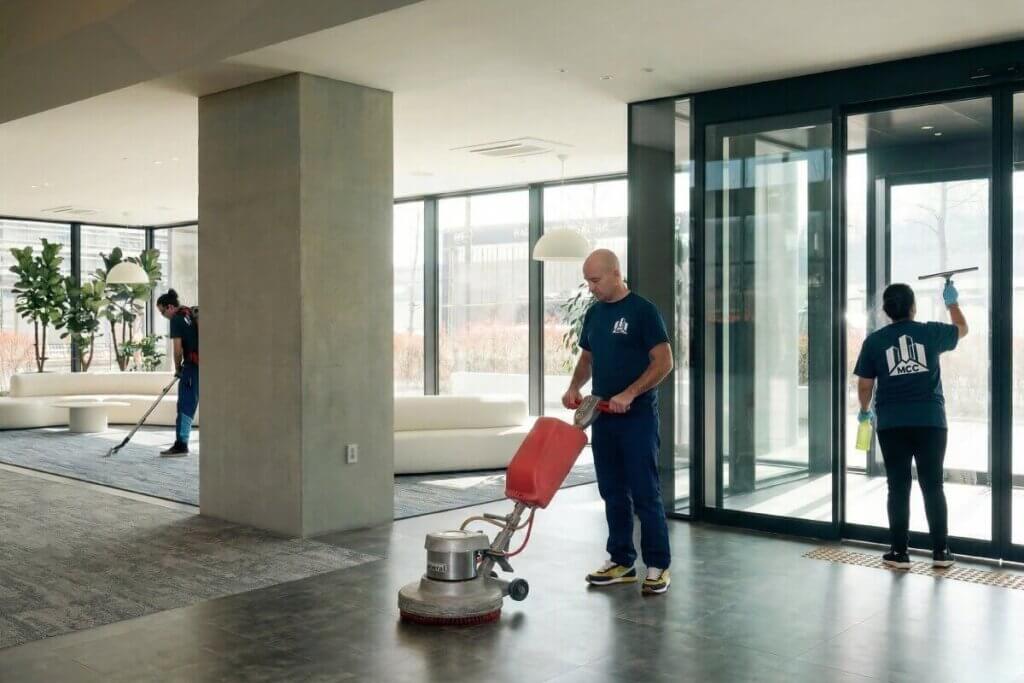
The scope varies by facility, but most programs cover the same ground:
- In lobbies, the porter wipes entry glass, straightens reception and waiting areas, and keeps elevators presentable.
- In restrooms, the porter restocks paper, soap, and liners and makes scheduled checks to catch problems early.
- In breakrooms, the porter handles spills, empties trash, wipes appliances and counters, and keeps the space usable through the lunch rush.
Safety is part of the job too. A porter who responds to a spill within minutes lowers the chance of a fall. OSHA’s walking-working surfaces standard expects employers to keep those surfaces free of hazards such as spills and to inspect them regularly. Someone on site makes that expectation far easier to meet.
Day porters also support the business side of the building. They set up conference rooms, clear catering, reset chairs, and prepare spaces for executive meetings or VIP visits. They monitor supplies, report burnt-out lights or leaks to building staff, and coordinate with on-site maintenance so small issues do not grow into tenant complaints.
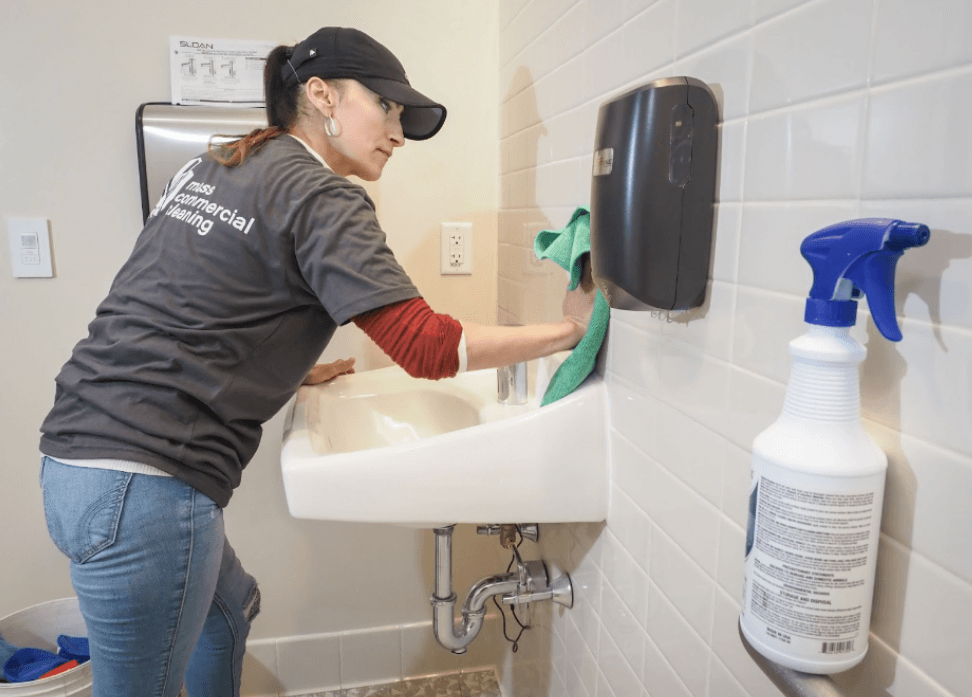
A corporate office porter service also shapes how people feel about the workplace. Employees notice when restrooms stay fresh and shared spaces stay orderly. Tenants notice too, and visible daytime care can influence how they judge management when renewal time arrives.
Typical Day Porter Responsibilities
| Area | Day Porter Tasks | Business Value |
| Lobby and entrance | Maintain presentation, address spills, monitor entry areas | Strong first impression for clients and tenants |
| Restrooms | Restock supplies, spot clean, monitor condition | Better employee and visitor experience |
| Breakroom | Manage trash, spills, surfaces, and supplies | Supports hygiene and daily usability |
| Conference rooms | Prepare rooms, remove debris, reset spaces | Helps meetings start on time |
| High-traffic zones | Respond to messes and maintain walkways | Reduces safety and appearance issues |
What Is Nighttime Janitorial Cleaning?
Nighttime janitorial cleaning handles the detailed work that cannot happen while people occupy the space. Crews arrive after business hours and work without interruption. That lets them scrub, buff, and sanitize thoroughly instead of cleaning around people.
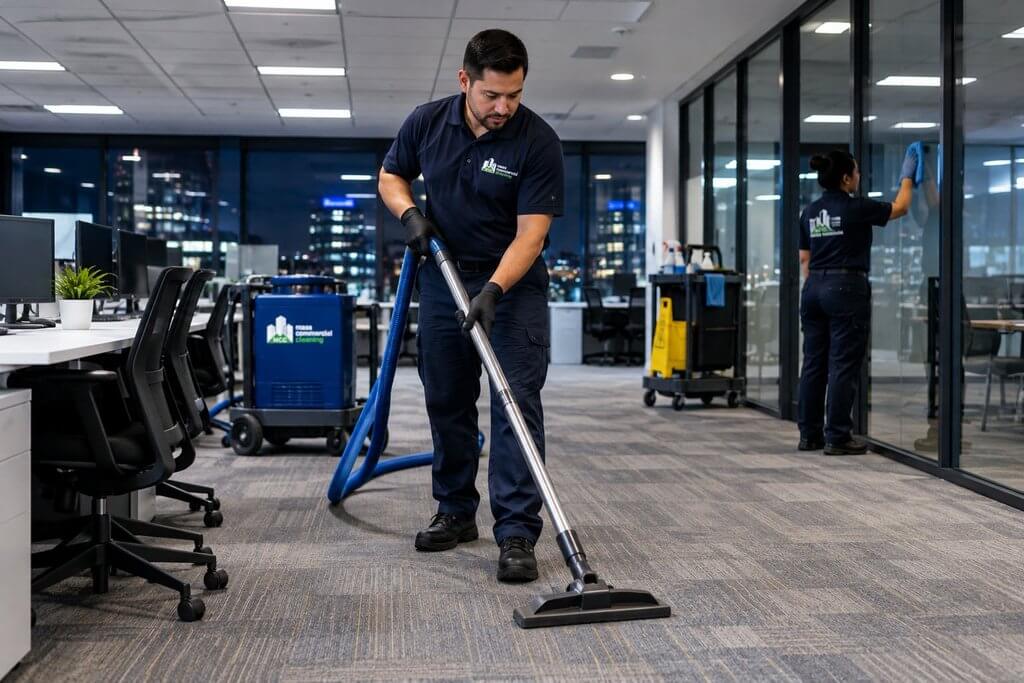
Restrooms show the difference clearly. At night, crews can fully disinfect fixtures, partitions, floors, and touch points, then restock so everything is ready by morning. On floors, they vacuum carpet and mop hard surfaces. When the flooring calls for it, they also buff, burnish, or scrub to protect the finish and restore its appearance. They remove trash, replace liners, dust surfaces, disinfect shared touch points, clean breakrooms, and wipe down workstations where the scope includes them.
Working after hours also avoids practical headaches. Floor machines run loudly, wet floors create slip risk, and cleaning products need ventilation and contact time. Doing that work in an empty building protects employees, tenants, meetings, and visitors from disruption.
For these reasons, night cleaning usually forms the foundation of a strong commercial janitorial program. It resets the building every day, and daytime staff could not match that depth in occupied space. Even so, night cleaning alone leaves a gap since nobody is on site between the crew’s departure and the next morning’s rush. That gap sits at the heart of the day porter vs night cleaning debate.
Typical Night Cleaning Responsibilities
| Area | Night Cleaning Tasks | Operational Benefit |
| Restrooms | Deep clean and disinfect fixtures and surfaces | Starts the next day hygienic and stocked |
| Floors | Vacuum, mop, buff, scrub, or restore as needed | Protects flooring and improves appearance |
| Workspaces | Dust, empty trash, clean surfaces | Supports a healthier office environment |
| Breakrooms | Clean appliances, counters, sinks, and floors | Removes buildup that daytime spot cleaning cannot address |
| Common areas | Complete detailed cleaning with fewer interruptions | More thorough work in less disrupted conditions |
Day Porter vs Night Cleaning: Cost, Visibility, and Operational Impact
The three models solve different problems, so the comparison below looks at purpose, visibility, response time, depth, fit, and cost side by side.
Day Porter vs. Night Cleaning vs. Hybrid Model
| Factor | Day Porter | Night Cleaning | Hybrid Model |
| Primary purpose | Continuous daytime upkeep | After-hours deep cleaning | Ongoing care plus detailed cleaning |
| Visibility | High; staff and visitors see active care | Low; work occurs outside business hours | Balanced |
| Response time | Immediate | Delayed until next service visit | Immediate for daytime issues |
| Cleaning depth | Spot cleaning and maintenance | Deep cleaning and restoration | Comprehensive |
| Best fit | Busy lobbies, corporate offices, multi-tenant buildings | Offices needing thorough after-hours service | High traffic or image-sensitive facilities |
| Cost pattern | Usually higher because of dedicated daytime staffing | Often more cost efficient for routine deep cleaning | Higher than night-only, but often justified by facility needs |
Cost Deserves a Plain Look
Actual pricing depends on hours, headcount, building size, and scope, so treat the pattern in the table as general guidance rather than a quote. A dedicated daytime position costs more because someone staffs your building during business hours. Night crews spread their work across a large footprint, which often makes routine deep cleaning more efficient. If you compare day porter vs night cleaning on price alone, night service looks like the obvious winner. Add tenant complaints, visitor impressions, and staff time spent chasing problems, and the picture changes. Many facilities control cost by scheduling a porter for peak windows instead of a full day.
Visibility Matters More Than Most Budgets Admit
Night work leaves no visible trace except the results, while a porter’s daytime presence shows employees and visitors that someone is paying attention. Response time follows the same split. A spill at 11 a.m. waits until tonight under a night-only plan, but a porter handles it in minutes.
Security and Staffing Also Differ
Day porters work around your people and visitors, so they need clear sign-in procedures, identification, and defined zones. Night crews usually need after-hours access through badges, keys, or alarm codes, which puts access control, supervision, and vendor management front and center.
So When Does Each Model Make Sense?
Night cleaning alone fits offices with predictable, moderate traffic, few visitors, and limited shared amenities. Day porter coverage on its own works when another team already handles deep cleaning or when the main problem is daytime presentation. A hybrid model fits multi-tenant buildings, client-facing lobbies, busy conference floors, and any facility where appearance affects business. In practice, the day porter vs night cleaning question rarely has a one-size answer.
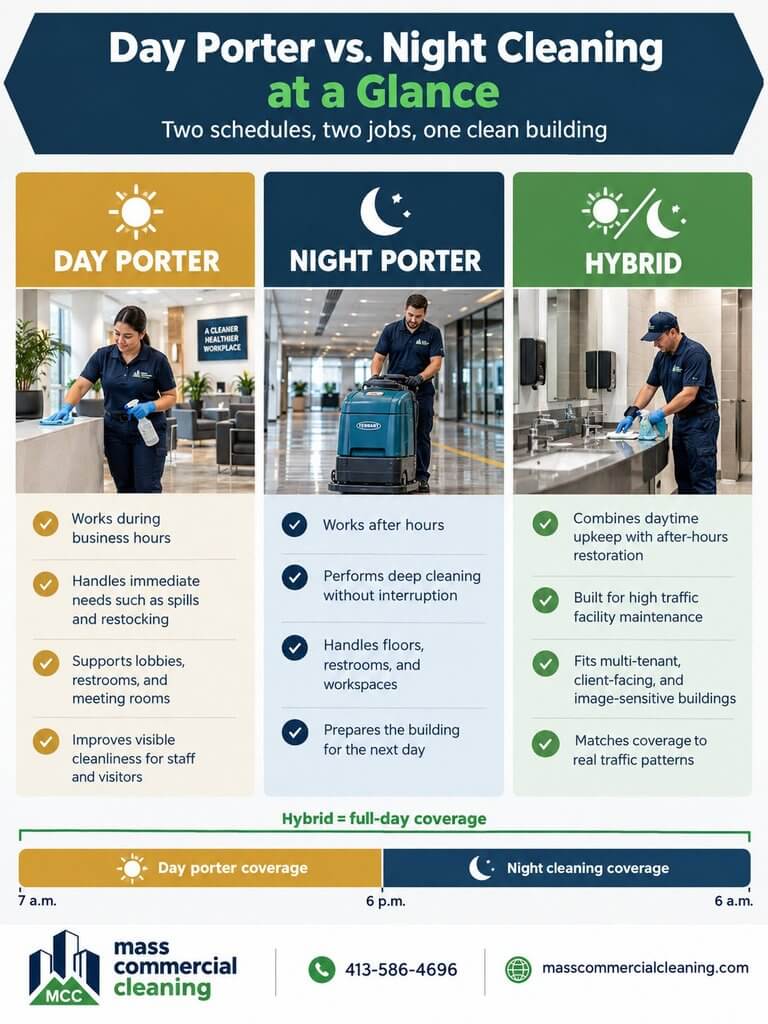
Expert observation: A clean building at 8 a.m. does not guarantee a clean building at 3 p.m. Facilities with heavy visitor traffic, shared restrooms, active conference schedules, or customer-facing lobbies often need daytime support in addition to nightly cleaning.
How to Determine Your Facility’s Ideal Cleaning Hybrid
A good decision starts with facts from your own building, not a generic rule. Work through the factors below, and the day porter vs night cleaning choice gets much easier.
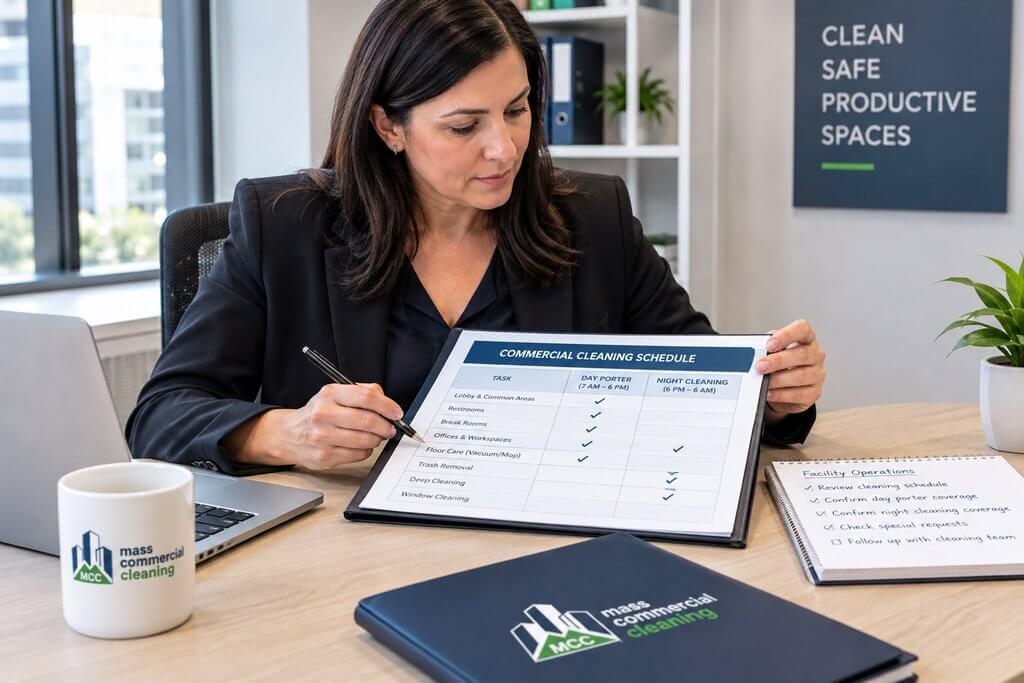
Foot Traffic
Count employees, visitors, deliveries, and meeting attendees, and note when your peak periods hit. A building with 30 people and few visitors has different needs from one with 300 people and constant client traffic. Check restroom and breakroom conditions at 10 a.m., noon, and 3 p.m., not just at closing.
Tenant Density
A single-tenant office controls its own schedule and standards. A multi-tenant building shares lobbies, elevators, and restrooms among groups with different expectations, so common areas wear faster and complaints land on property management.
Facility Type
Corporate headquarters, medical or professional offices, educational spaces, financial institutions, industrial offices, and mixed-use properties each carry different expectations for appearance, hygiene, and compliance. Client-facing sites tend to lean toward hybrid coverage.
Security Access
Consider after-hours access, badge systems, escort requirements, and vendor management. Night service needs a smooth, accountable entry process. Day service needs visitor-friendly protocols.
Budget Constraints
Prioritize high-impact areas instead of simply cutting cleaning frequency. A porter focused on lobbies and restrooms during peak hours can protect the spaces people judge most, while the night crew handles everything else.
Existing Complaints
Track restroom supplies, lobby appearance, breakroom conditions, spills, and meeting-room readiness. Recurring complaints point straight to the gap in your current schedule.
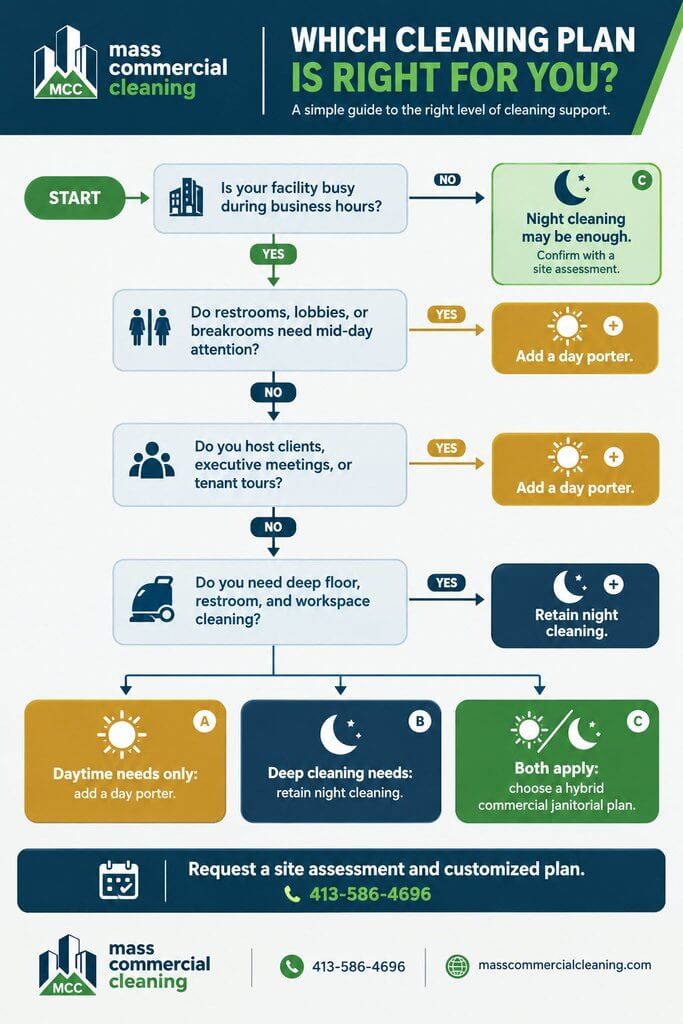
Checklist: Choose the Right Cleaning Schedule
- Count daily employees, visitors, deliveries, and meeting attendees.
- Identify the areas that create the most complaints or visible wear.
- Review restroom and breakroom usage during peak hours.
- Check whether after-hours access is simple, restricted, or requires coordination.
- Identify client-facing spaces where appearance directly affects business perception.
- Decide which tasks must happen during business hours.
- Decide which tasks can be completed after hours.
- Request a site assessment and customized scope from a commercial cleaning company.
When Should Facilities Hire Commercial Cleaning Professionals?
Some buildings outgrow in-house cleaning or a loosely managed vendor arrangement without anyone noticing. Watch for these warning signs:
- Restrooms or breakrooms deteriorate before the end of the workday.
- Lobby and conference-room appearance varies from day to day.
- Staff spend time managing cleaning complaints or supplies.
- Night cleaning is inconsistent, rushed, or poorly supervised.
- The facility has grown, added tenants, or increased visitor traffic.
- Leadership wants documented quality control and accountable service.
If two or three of these sound familiar, your current setup is costing you more than it appears. Professional janitorial services bring consistency, because trained crews follow a defined scope instead of improvising. They bring accountability, because a managed team answers to a supervisor and a documented process. They also improve safety and presentation, since the same people handle the same spaces on a reliable schedule.
Facilities with broader needs can also look at full-scope commercial cleaning services, which can cover floors, carpets, disinfection, windows, and post-construction cleanup alongside daily upkeep. A provider who can assess the building in person can then recommend the right day porter vs night cleaning mix instead of guessing from a floor plan.
Why Choose an Employee-Owned Cleaning Company Instead of a National Franchise?
Since 1989, Mass Commercial Cleaning has served Massachusetts businesses across our great state. In 2021 our commercial cleaning company became an employee-owned company. This structure matters in practice. When the people cleaning your building also own part of the company, they have a direct stake in how the work turns out, and that tends to sharpen accountability.
Local ownership adds its own advantages. It can mean faster communication, more flexible scheduling, and familiarity with regional facility needs, from winter entrance mats to the way New England buildings handle heavy seasonal traffic. A local commercial cleaning company can also build a customized plan around your building instead of applying a rigid franchise template.
Mass Commercial Cleaning pairs employee ownership with trained and managed teams, documented quality-control processes, full insurance coverage, and environmentally responsible practices, including FAC-114 Certified Green Cleaning. Product choice matters here. EPA’s Safer Choice program exists to help facility purchasers find cleaning products made with safer chemical ingredients, and asking any provider how it selects products is a fair question.
None of this means a franchise cannot do good work. The right choice depends on service consistency, supervision, communication, and fit with your facility, not company size. Ask every provider how it trains crews, supervises night work, handles complaints, and adjusts schedules. Those answers predict how service will look in month six, not just week one, whatever day porter vs night cleaning mix you choose. Our team serves Hampden, Hampshire, Worcester, and Middlesex Counties, and you can review our commercial cleaning service areas to confirm coverage for your building.
Frequently Asked Questions
What is the difference between day porter vs night cleaning?
Day porters work during business hours, handling spills, restroom checks, lobby upkeep, and meeting setup. Night cleaning happens after hours and covers deep tasks such as floors, restroom sanitation, and trash removal. Many offices use both for complete coverage.
Does my office need both a day porter and night cleaning?
Not always. Quiet single-tenant offices often manage with nightly cleaning alone. Buildings with heavy visitor traffic, shared restrooms, or active conference rooms usually benefit from both, because daytime upkeep and nightly deep cleaning solve different problems.
What does a corporate office porter service include?
It typically includes lobby upkeep, restroom checks and restocking, breakroom tidying, spill response, conference room turnover, and reporting maintenance issues. Scope varies by building, so a site assessment should define tasks, hours, and supply responsibilities.
How often should high traffic facility maintenance be performed?
It depends on traffic. CDC guidance says busier spaces may need more frequent cleaning of high-touch surfaces, so many facilities schedule restroom and lobby checks several times daily, plus nightly cleaning, then adjust based on usage and complaints.
Is day porter service disruptive to employees?
No. A well-managed day porter works quietly around meetings and peak hours, using low-noise methods and a clear schedule. Most employees notice the results, such as stocked restrooms and tidy lobbies, rather than the work itself.
How do I choose between commercial janitorial options?
Start with traffic, tenant expectations, security access, and budget. Decide which tasks must happen during business hours and which can wait until after hours, then request a site assessment so a provider can build a customized scope.
Get a Commercial Cleaning Plan Built for Your Facility
The decision comes down to what your building needs and when. Day porter services solve daytime presentation and response needs: stocked restrooms, tidy lobbies, ready meeting rooms, and fast spill response. Night porter services deliver the detailed after-hours cleaning that resets floors, restrooms, and workspaces for the next day. Many offices benefit from a hybrid schedule that combines both, with coverage matched to real traffic patterns instead of guesswork.
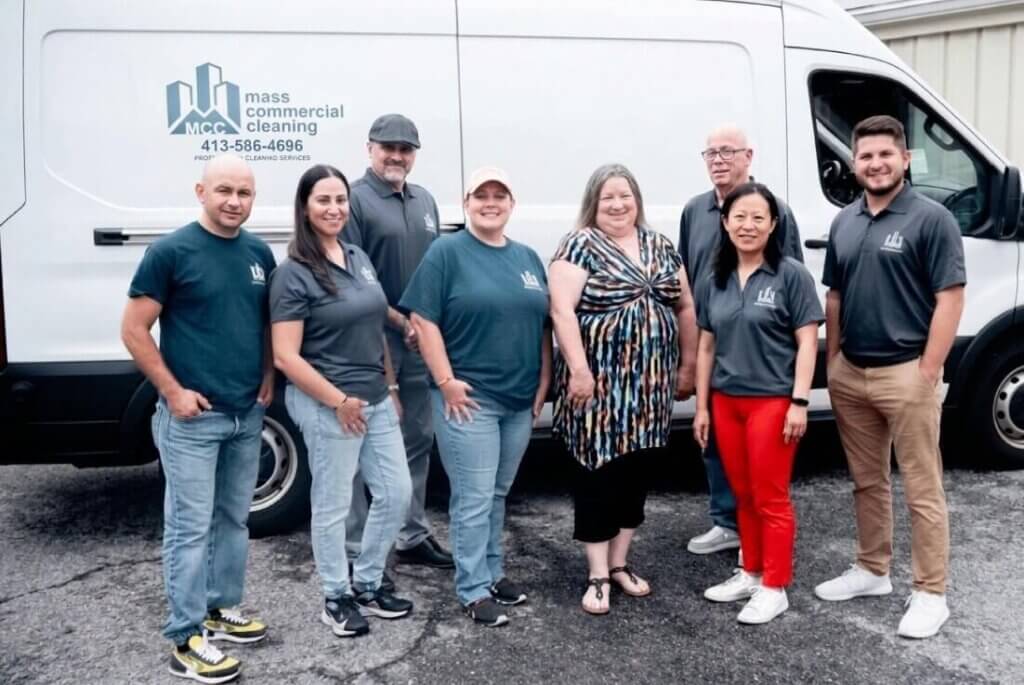
Mass Commercial Cleaning can walk your facility, listen to your concerns, and build a customized cleaning plan around them. We serve businesses across Hampden, Hampshire, Worcester, and Middlesex Counties (see the areas we serve), and every plan starts with a facility assessment.
Call 413-586-4696 or request a no-obligation quote through our website. Whether your answer to day porter vs night cleaning turns out to be one, the other, or both, we will help you sort it out, and you can decide what comes next at your own pace.
