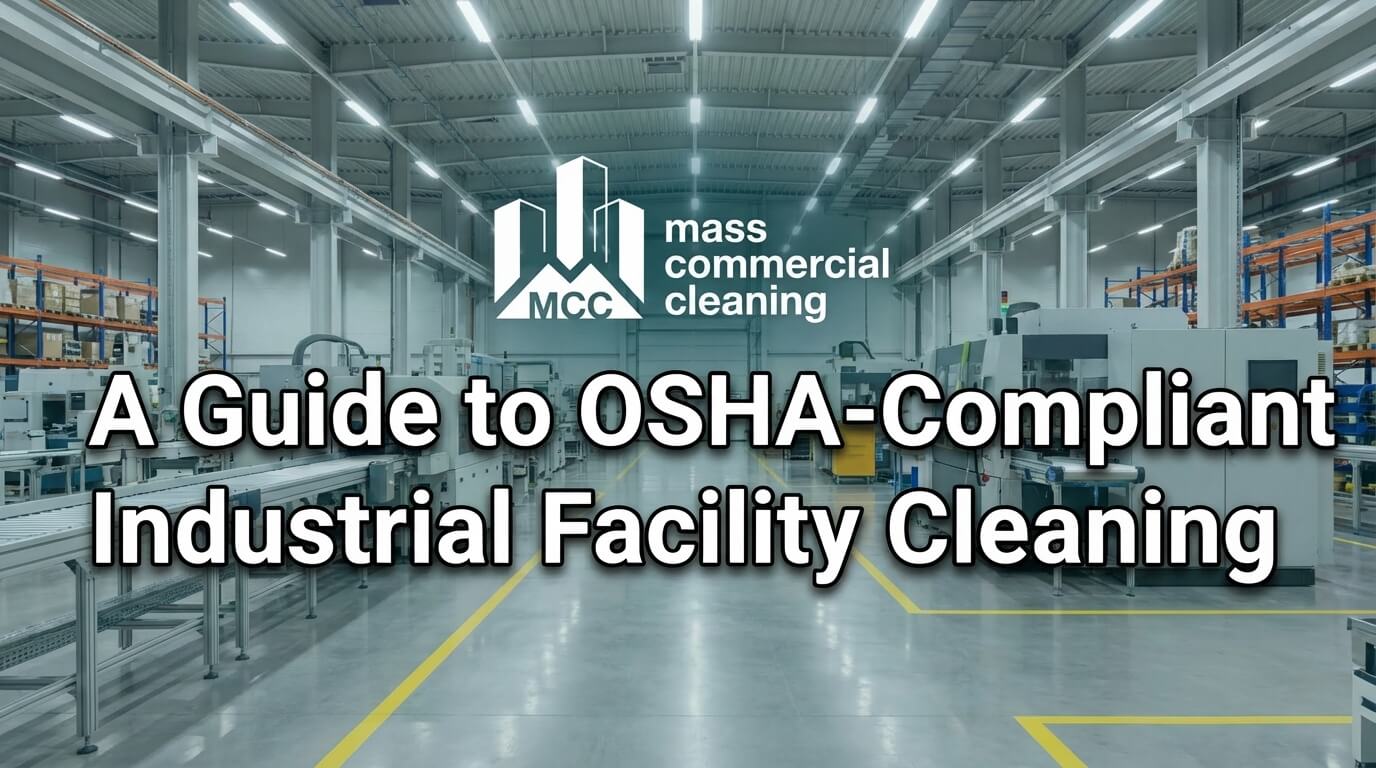
Managing an industrial facility in Massachusetts requires balancing operational efficiency with strict adherence to safety regulations. For facility managers overseeing a warehouse, manufacturing plant, or distribution center, ensuring that commercial cleaning protocols align with OSHA standards is not optional — it is a legal and moral imperative.
OSHA’s mandate is to ensure safe and healthful working conditions by setting and enforcing standards. When it comes to industrial cleaning, several specific standards come into play, each addressing distinct workplace hazards that professional commercial cleaning teams must recognize and mitigate without disrupting your daily operations.
This guide to OSHA-compliant industrial facility cleaning will help you both navigate OSHA’s standards and select an industrial cleaning company to keep your team safe in compliance with the latest regulations.
Hazard Communication Standard
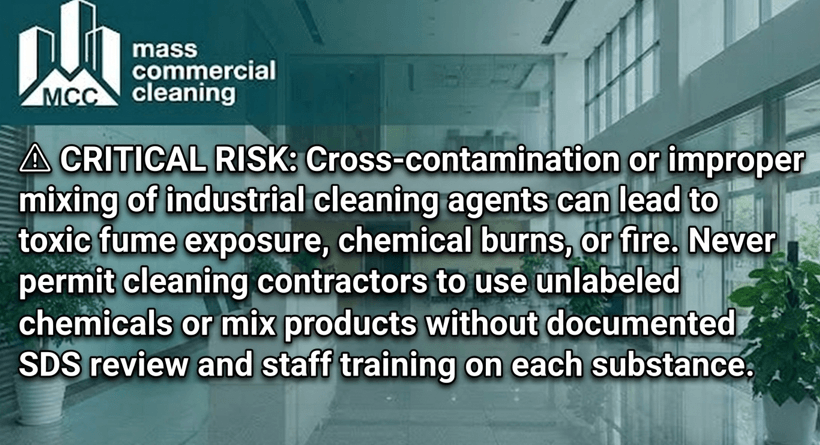
The Hazard Communication Standard ensures that information about chemical and toxic substance hazards in the workplace is disseminated to workers and that associated protective measures are clearly communicated. Cleaning industrial spaces often requires heavy-duty degreasers, industrial solvents, and specialized floor strippers — all of which present significant risks if improperly handled.
| Requirement | What It Means | Responsible Party | Consequence of Non-Compliance |
|---|---|---|---|
| Safety Data Sheets (SDS) | Maintained and accessible for every chemical on-site | Cleaning contractor | OSHA citation, fines up to $15,625/violation |
| Container labeling | All containers clearly labeled with contents and hazards | Contractor + facility | Risk of chemical burns, toxic exposure |
| Employee training | Staff trained on handling, storing, and disposing of hazardous substances | Cleaning company | Fines + increased liability for injuries |
| Written HazCom program | Documented program accessible to all employees | Facility manager | Serious OSHA violation classification |
| Chemical inventory list | Updated list of all hazardous chemicals on premises | Both parties | Inability to produce during OSHA inspection |
The Walking Working Surfaces Standard
Slips, trips, and falls are among the leading causes of workplace injuries and fatalities. OSHA’s Walking-Working Surfaces standard (29 CFR 1910.22) requires that all places of employment, passageways, storerooms, and walking-working surfaces are kept in a clean, orderly, and sanitary condition at all times.
In a manufacturing or warehouse setting, oil spills, grease buildup, and debris are constant threats. A compliant cleaning program must include strategic floor care protocols executed with proper industrial equipment.
Leading causes of industrial workplace injuries:
Slips, trips & falls — 35%
Overexertion — 28%
Contact with objects — 19%
Transportation incidents — 11%
Exposure to harmful substances — 7%
Floor Cleaning Protocol: Compliance vs. Non-Compliance
| Scenario | Compliant Approach | Non-Compliant Approach |
|---|---|---|
| Oil/grease spill | Immediate containment, industrial degreaser, ride-on scrubber, dry verification | Mop with general cleaner, leave damp |
| Routine floor maintenance | Industrial ride-on scrubber with squeegee, wet floor signage, dry-pass verification | Consumer mop and bucket, no signage |
| Post-shift cleanup | HEPA vacuum debris, scrub, inspect for residual slick, wet floor signs until dry | Sweep and leave, no signage |
| High-traffic aisles | Daily scrubbing schedule, non-slip treatment applied quarterly | Ad-hoc cleaning only when visibly dirty |
| Forklift traffic areas | Traction-enhancing coatings, routine scrubbing, debris removal | Standard floor cleaning without traction audit |
Managing Combustible Dust and Airborne Particulates
One of the most commonly overlooked hazards in industrial facilities is combustible dust. Materials like wood, metal, grain, and certain plastics can generate dust that, when suspended in the air in the right concentration, can ignite and cause catastrophic explosions.
Standard sweeping or using compressed air to clean machinery worsens dust problems by kicking settled dust into the air. Even a 1/32″ accumulation over 5% of a room’s surface area is enough fuel for a devastating explosion.
Combustible Dust Types by Risk Level
| Dust Type | Common Sources | Risk Level | Required Cleaning Method |
|---|---|---|---|
| Metal dust (Al, Mg) | Machining, grinding, polishing | EXTREME | HEPA vac rated for combustible dust |
| Wood dust | Sawing, sanding, routing | HIGH | HEPA vacuum + overhead dusting program |
| Grain / organic dust | Food processing, agriculture | HIGH | Intrinsically safe HEPA equipment |
| Plastic / resin dust | Injection molding, cutting | MODERATE-HIGH | HEPA vac + anti-static protocols |
| Coal / carbon dust | Fuel handling, printing | EXTREME | Explosion-proof rated equipment only |
| Sugar / starch dust | Food processing, pharmaceuticals | HIGH | HEPA filtration, strict housekeeping schedule |
Recommended High-Level Dusting Frequency by Facility Type
| Facility Type | Rafters & Overhead | HVAC Ductwork | Machinery Surfaces |
|---|---|---|---|
| Metal fabrication / machining | Monthly | Quarterly | Weekly |
| Woodworking / lumber | Bi-monthly | Quarterly | Weekly |
| Food processing / grain | Monthly | Quarterly | Daily |
| General warehouse | Quarterly | Semi-annually | Monthly |
| Distribution / logistics | Semi-annually | Annually | Monthly |
| Light manufacturing | Quarterly | Semi-annually | Bi-weekly |
Personal Protective Equipment Requirements
OSHA mandates that employers provide appropriate Personal Protective Equipment to employees. A reputable commercial cleaning company must fully outfit their staff with the necessary gear before entering your facility, and must document that training has occurred.
| PPE Item | When Required | OSHA Standard | Cleaning Application |
|---|---|---|---|
| Heavy-duty chemical gloves | Always during chemical handling | 29 CFR 1910.138 | Degreaser application, solvent use |
| Safety goggles / face shield | Chemical mixing, overhead work | 29 CFR 1910.133 | Pressure washing, solvent application |
| Slip-resistant footwear | All times on industrial floors | 29 CFR 1910.136 | Floor scrubbing, wet environments |
| Respirator (N95 or P100) | Combustible dust, solvent vapors | 29 CFR 1910.134 | Dust cleanup, chemical applications |
| High-visibility vest | Active forklift traffic areas | 29 CFR 1910.178 | Aisle cleaning, warehouse work |
| Hearing protection | High-noise equipment operation | 29 CFR 1910.95 | Ride-on scrubber use in loud zones |
| Hard hat | Overhead work or falling object risk | 29 CFR 1910.135 | High-level dusting, rafter cleaning |
Your Blueprint for Hiring an Industrial Building Cleaning Service
Selecting the right commercial cleaning partner is one of the most consequential decisions a facility manager will make. The wrong vendor can expose your operation to OSHA fines, workplace injuries, and costly insurance claims.
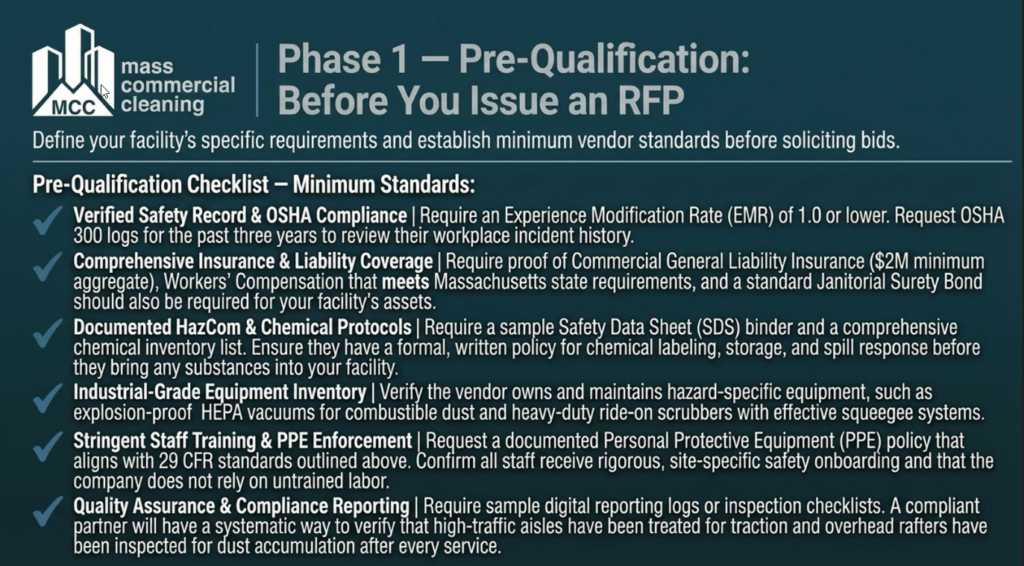
Phase 1 — Pre-Qualification: Before You Issue an RFP
Before soliciting bids, define your facility’s specific requirements and establish minimum vendor standards.
Phase 2 — The Evaluation Matrix: Scoring Your Bidders
Use the table below to help score the company on each evaluation criteria. We’ve given each store a weight in the calculations to help you compare service providers more accurately.
| Evaluation Criteria | Weight | Score (1–5) | Weighted Score |
|---|---|---|---|
| OSHA safety compliance documentation | 25% | ___ / 5 | ___ × 0.25 |
| Industrial equipment capability | 20% | ___ / 5 | ___ × 0.20 |
| Relevant industry experience | 15% | ___ / 5 | ___ × 0.15 |
| Employee training programs | 15% | ___ / 5 | ___ × 0.15 |
| Insurance coverage adequacy | 10% | ___ / 5 | ___ × 0.10 |
| Flexibility with operational hours | 10% | ___ / 5 | ___ × 0.10 |
| Pricing transparency & value | 5% | ___ / 5 | ___ × 0.05 |
| TOTAL | 100% | ___ / 5.00 |
Phase 3 — Contract Essentials: What to Include
Contracts with your cleaning vendor can vary in complexity and structure depending on the scope of the project. But these essential elements must be included within signed document
| Contract Provision | Why It Matters | Red Flag if Missing |
|---|---|---|
| Chemical SDS access clause | Guarantees you can review all chemicals before use | Vendor may use unapproved substances |
| PPE compliance warranty | Confirms vendor provides and enforces PPE | Your facility inherits liability |
| Background check confirmation | Security for your facility and staff | Insurance may not cover incidents |
| Incident reporting protocol | Defines how accidents are documented and reported | OSHA recordkeeping violations |
| Equipment specification list | Confirms industrial-grade tools are used | Consumer equipment creates hazards |
| Combustible dust protocol clause | Mandates correct cleaning methods for your dust type | Explosion risk from incorrect methods |
| Right to audit provision | Allows you to inspect SDS binders and training records | No visibility into compliance |
| OSHA violation indemnification | Contractor bears cost of violations from their work | You pay the fines |
Phase 4 — Onboarding: Site-Specific Safety Integration
The below timeline gives you an insight into what to expect from the moment the new industrial cleaning provider conducts their first walkthrough.
| Week | Milestone | Facility Manager Action | Vendor Action |
|---|---|---|---|
| 1 | Site walkthrough & hazard mapping | Identify all hazard zones, dust types, chemical storage areas | Document scope, confirm equipment list, review SDS |
| 2 | Safety protocol review | Share site-specific safety rules and emergency procedures | Train staff on site rules, issue site-specific PPE |
| 3 | Trial clean & inspection | Audit first clean: check floor dryness, signage use, chemical handling | Execute cleaning per scope, document any issues |
| 4 | Debrief & protocol lock-in | Sign off on final cleaning protocol document | Finalize SDS binder for your facility, submit training records |
Red Flags When Evaluating Industrial Cleaning Vendors
Immediate disqualifiers:
- Cannot produce SDS for chemicals they plan to use
- No workers’ compensation insurance for cleaning staff
- Proposes standard janitorial mops for large industrial floors
- Refuses site walkthrough before quoting
- Cannot provide written OSHA training records
Proceed with caution:
- Uses subcontractors for industrial cleaning work
- Unable to provide prior industrial client references
- Quoted price seems unusually low
- Limited experience with your specific dust type
- No documented cleaning protocol or scope of work
Special Cleaning Requirements Beyond Basic Industrial Cleaning
| Scenario | Required Expertise | Equipment Needed | OSHA Standard |
|---|---|---|---|
| Bloodborne pathogen spill | OSHA Bloodborne Pathogen training | EPA-registered disinfectants, biohazard disposal kit | 29 CFR 1910.1030 |
| Post-chemical spill remediation | HazMat awareness, chemical neutralization protocols | Neutralizing agents, HEPA vac, full PPE | 29 CFR 1910.120 |
| Post-fire soot & ash cleanup | HEPA filtration, carcinogen awareness | P100 respirators, HEPA vacuums, sealed disposal bags | 29 CFR 1910.134 |
| Confined space pre-entry cleaning | Confined Space Entry permit awareness | Explosion-proof equipment, gas monitor, safety harness | 29 CFR 1910.146 |
| Food-grade facility sanitation | FSMA/FDA sanitation + OSHA compliance | NSF-certified detergents, sanitizers, color-coded tools | 29 CFR 1910 + FDA FSMA |
Frequently Asked Questions About OSHA Standards for Industrial Cleaning
What does OSHA’s Hazard Communication Standard require of commercial cleaners?
Commercial cleaners must maintain accessible Safety Data Sheets for all chemicals used, ensure all containers are properly labeled, and document that staff have undergone training on the safe handling and disposal of hazardous substances. Your facility has the right to request these records at any time.
How do commercial cleaners safely manage combustible dust in a warehouse?
Professionals use intrinsically safe HEPA vacuums rated for combustible dust environments to safely capture particles rather than sweeping or using compressed air — both of which dangerously disperse explosive particulates into the air. High-level dusting programs for rafters, ductwork, and overhead pipes are equally critical.
Why is standard janitorial equipment insufficient for industrial floor cleaning?
Industrial floors accumulate heavy grease, oil, and forklift tire marks that require heavy-duty ride-on scrubbers and industrial-grade degreasers to prevent dangerous slip-and-fall hazards. Consumer mops spread contaminants rather than removing them and leave floors damp and slippery.
Are commercial cleaners required to bring their own PPE to an industrial site?
Yes. A professional commercial cleaning company is responsible for providing their staff with all necessary Personal Protective Equipment — safety goggles, gloves, respirators, slip-resistant footwear, and more — in accordance with OSHA standards. Your facility should verify this before contractors enter your site.
How often should an industrial facility undergo high-level dusting?
The frequency depends on the type of manufacturing or storage. Metal fabrication and food processing facilities may require monthly high-level dusting, while general warehouses may only need quarterly service. The key variable is the combustibility rating and accumulation rate of your specific dust type.
What happens if an employee uses an improperly labeled cleaning chemical?
Improperly labeled chemicals violate OSHA’s HAZCOM standard and can lead to dangerous chemical reactions, toxic exposure, and severe fines for the facility. The cleaning contractor bears responsibility for proper labeling, but facility managers are also liable if they permit non-compliant chemicals on-site.
Can a standard cleaning crew handle a bloodborne pathogen spill on the warehouse floor?
No. Blood and bodily fluid cleanup requires specialized training, specific EPA-registered disinfectants, and strict disposal protocols outlined by OSHA’s Bloodborne Pathogens standard (29 CFR 1910.1030). Using an unqualified crew creates serious health risks and significant OSHA exposure for your facility.
What role does floor cleaning play in forklift safety?
Consistent floor scrubbing removes debris, oil, and pallet splinters that can cause forklift tires to lose traction, slide, or puncture, directly reducing collision and tip-over risks in high-traffic warehouse areas.
How do I verify that my current cleaning service is OSHA compliant?
Request their Safety Data Sheets binder for all chemicals used in your facility, their written Hazard Communication program, documentation of PPE issuance and training records for each staff member, and evidence of any OSHA 10 or 30 certifications held by supervisory staff.
Book Your Cleaning Services Quote with Massachusetts’ Leaders in Industrial Facility Cleaning
Mass Commercial Cleaning’s team brings decades of site-specific industrial facility cleaning experience to each project. Our employee-owners design protocols around your industry’s compliance requirements, your team’s hours, your operational requirements and building floorplan.
Discover why we’re the Massachusetts leader for OSHA-compliant industrial facility cleaning services and call (413) 586-4696 to confirm your service quote.
